Philippines
Philippines Achieves Upper-Middle-Income Status Amid Economic Growth
The World Bank's recent upgrade of the Philippines to upper-middle-income status is attributed to robust exports and rising investments, officials say.
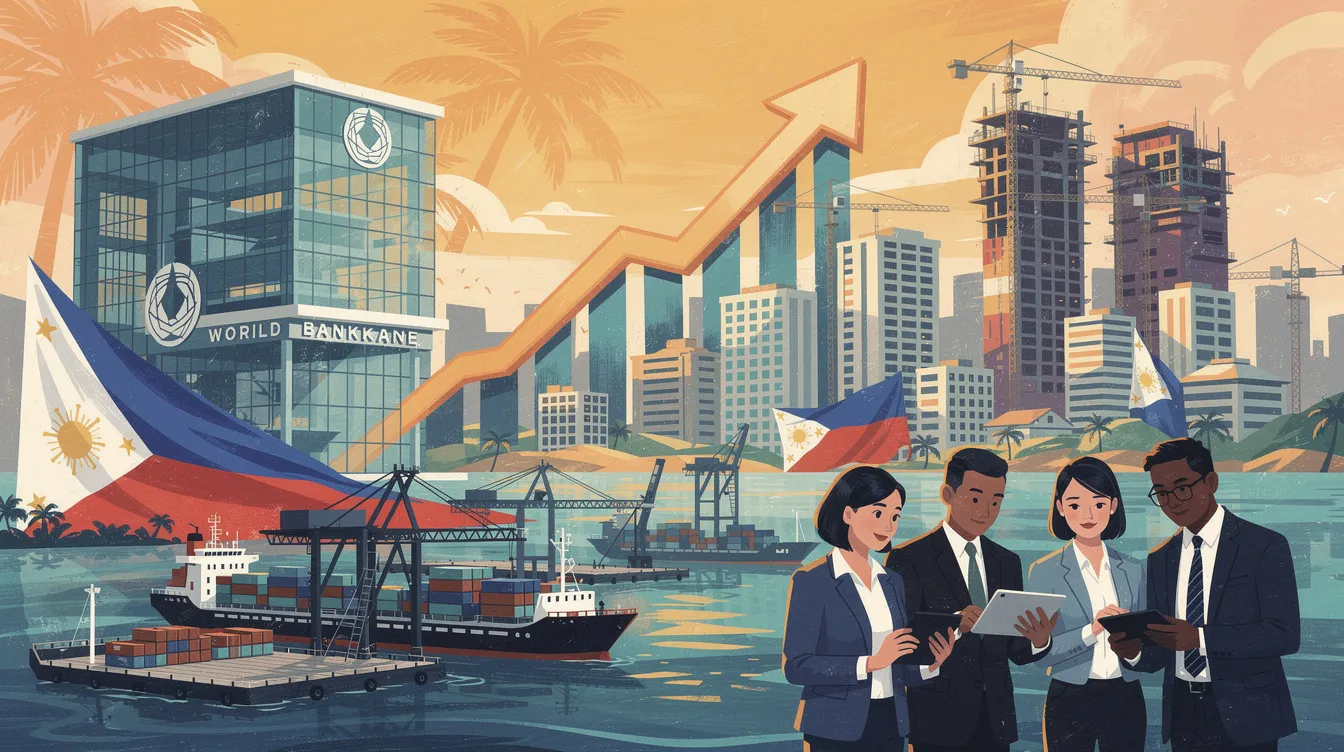
The Philippines has officially been upgraded to upper-middle-income country (UMIC) status by the World Bank, a development that officials attribute to the country’s impressive economic performance, particularly in exports and investments. Trade Secretary Cristina Roque highlighted this transition as a reflection of the Marcos administration's effective economic strategies.
According to Roque, the Philippines saw a remarkable surge in exports, which reached a historic high of $84.41 billion in 2025, marking a 15.2 percent increase from $73.27 billion in 2024. This upward trajectory has continued into 2026, with monthly export figures showing consistent growth: 7.9 percent ($7.09 billion) in January, 8 percent ($6.79 billion) in February, 20.4 percent ($8.17 billion) in March, 6.3 percent ($7.21 billion) in April, and 7.6 percent ($7.87 billion) in May.
Roque credited the Board of Investments (BOI) and the Philippine Economic Zone Authority (PEZA) for their substantial contributions, with the BOI approving investments totaling P1.56 trillion (approximately $28.5 billion) and PEZA endorsing P260.89 billion (around $4.8 billion) across 314 new and expansion projects. This significant influx of capital is seen as a key driver of the country’s economic ascent.
“This milestone is proof of the strong leadership of President Ferdinand R. Marcos Jr. in pushing for economic reforms that enhance the country’s global competitiveness and resilience,” Roque asserted, underscoring the administration's commitment to fostering an environment conducive to investment.
“This milestone is proof of the strong leadership of President Ferdinand R. Marcos Jr. in pushing for economic reforms that enhance the country’s global competitiveness and resilience.”Cristina Roque, Trade Secretary
The administration's efforts to pursue 23 free trade agreements and other international partnerships have also been pivotal in bolstering the economy. Roque noted that these trade pacts have systematically lowered trade barriers and broadened market access, thereby enhancing the global price competitiveness of Filipino exporters.
Furthermore, Roque emphasized that serving as the ASEAN Chair for 2026 presents an opportunity for the Philippines to showcase its economic progress on an international stage, attract high-value capital, and ensure that growth translates into sustainable, high-quality jobs for all Filipinos. The World Bank's classification was based on the Philippines achieving a gross national income per capita of $4,850 in 2025, surpassing the $4,636 threshold for UMIC status.
The Philippines is among five economies that transitioned from lower-middle to upper-middle-income status this year, joining the ranks of Jordan, Micronesia, Sri Lanka, and Vietnam, according to the World Bank.