Philippines
Filipino Students Innovate AI Drone Concepts for E-Commerce Logistics
Three student teams from the Philippines are set to showcase their AI-driven warehouse drone solutions at the Asia-Pacific finals of the FedEx/Junior Achievement International Trade Challenge.
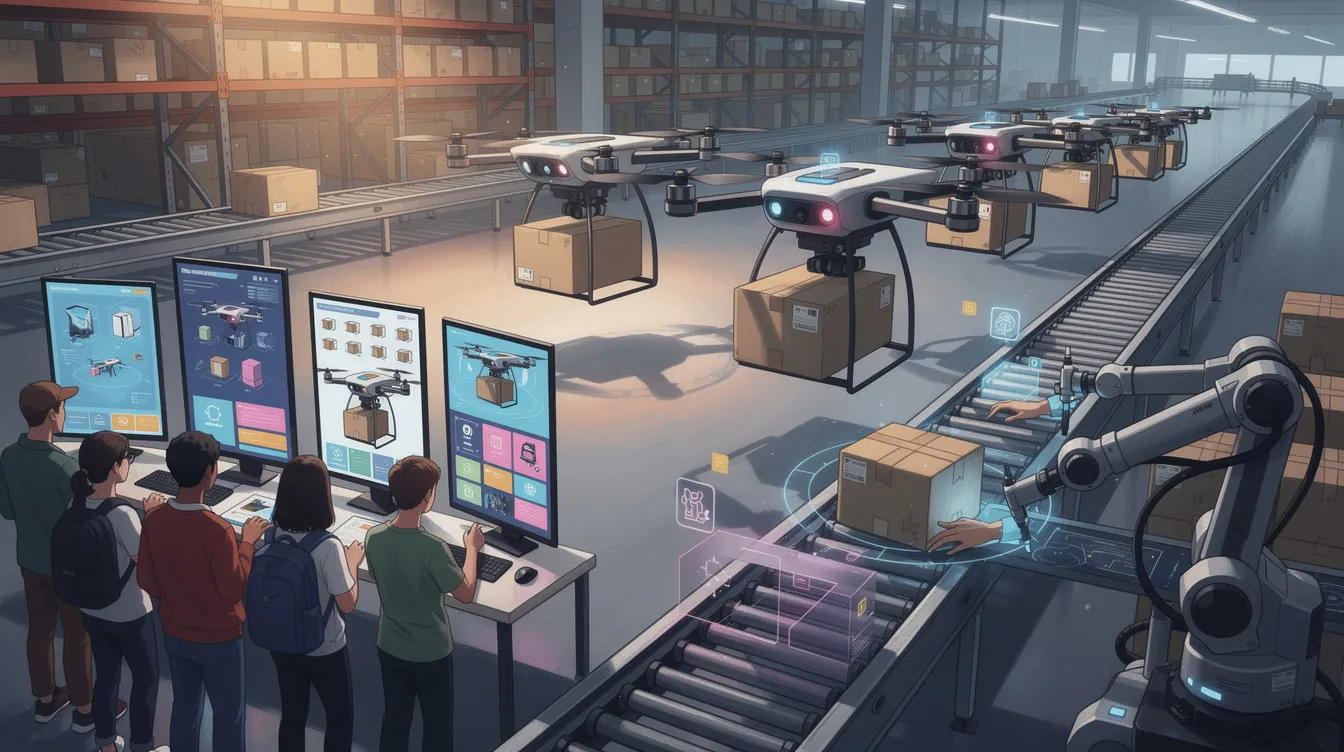
In a significant demonstration of innovation, three student teams from the Philippines are preparing to present their concepts for AI-powered autonomous drones at the upcoming Asia-Pacific finals of the FedEx/Junior Achievement International Trade Challenge in Singapore. This competition, which emphasizes entrepreneurship and international trade, has seen Filipino students excel in previous years, with notable finishes including first-place awards in 2020 and 2021.
The students' proposals focus on enhancing logistics operations in Vietnam, a country experiencing rapid growth in e-commerce. As demand for faster and more accurate logistics systems escalates, these concepts leverage advanced technologies such as artificial intelligence, computer vision, and autonomous navigation. According to the Manila Times, the challenge this year required participants to devise market entry strategies for their drone systems, highlighting the intersection of technology and business.
One of the standout projects, ArkSight, developed by Matthew John Hife and Lorente Jr. Berden from Mandaue City Comprehensive National High School, combines computer vision with ultra-high frequency radio-frequency identification (UHF RFID) to create an autonomous inventory drone. This technology enables the drone to recognize and process visual information while identifying tagged inventory without scanning individual barcodes. The system is designed for small and medium-sized logistics operations and is proposed to be offered through a Drone-as-a-Service model, minimizing upfront investment costs for companies.
Another team from the University of San Jose-Recoletos introduced Chuôn Chuôn, an AI-based inventory management system that integrates autonomous drones, wireless charging, and conversational AI. Students Minette Cabaluna and Jim Niño Gonzales proposed Chuôn2Bot, a Vietnamese-language AI assistant that would facilitate interaction between personnel and inventory information through natural language queries. This approach aims to enhance the accessibility of warehouse automation for logistics companies.
“The future of innovation depends on giving young people the opportunity to learn, collaborate, and think big.”Maribeth Espinosa, Managing Director, FedEx Philippines
The third concept, Altius AI, focuses on the specialized needs of cold-chain warehouses, which require stringent environmental monitoring alongside inventory management. Developed by Mico Alfonso Aviñante Nolledo and Nathan Trono Dy Pico from Everest International Academy, this proposal utilizes LiDAR mapping and AI-based irregularity detection to ensure optimal conditions for perishable goods. By integrating various sensors, the drone can operate as a mobile data collection platform, enhancing operational efficiency in cold-chain logistics.
These innovative solutions reflect a broader trend in the logistics sector, where the integration of AI and automation is becoming increasingly vital. The FedEx/JA International Trade Challenge, now in its 17th year in the Philippines, has engaged over 12,000 students since its inception in 2009, providing them with valuable exposure to international trade and entrepreneurship. FedEx Philippines Managing Director Maribeth Espinosa emphasized the importance of such programs, stating that the future of innovation depends on giving young people the opportunity to learn, collaborate, and think big.
As the Philippine teams prepare for the competition in Singapore, they will need to demonstrate how their emerging technologies can be practically applied in Vietnam's logistics market, showcasing the potential for AI-driven solutions to transform the industry.