Indonesia
Indonesia's Fuel Rationing: A Nation at a Crossroads
As fuel rationing begins, Indonesia grapples with rising oil prices and the implications of its subsidy regime.
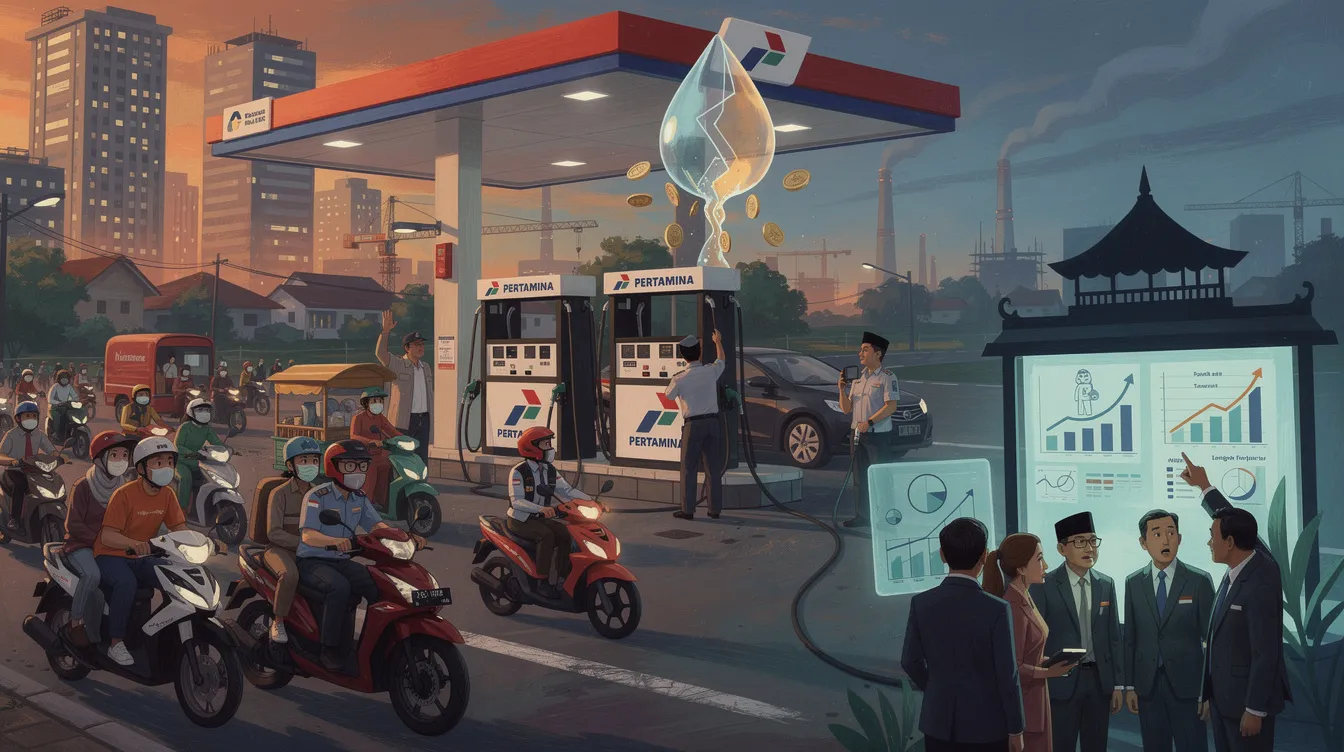
As the sun rises over Jakarta, long queues form at petrol stations, with frustrated drivers waiting for hours to fill up their tanks. The government has implemented a new fuel rationing policy, capping purchases at 50 litres per vehicle per day, a measure aimed at conserving dwindling energy stocks amid soaring global oil prices driven by geopolitical tensions. Civil servants are now required to work from home on Fridays, a move intended to further reduce energy consumption. This is not just a logistical challenge; it’s a reflection of a nation grappling with the consequences of its energy policies.
Indonesia's current predicament is a stark reminder of the complexities surrounding fuel subsidies. Once an oil exporter, the country has transformed into a net importer, relying heavily on foreign oil to meet its domestic demand. The Financial Times reports that Indonesia's currency has fallen sharply against the dollar, raising alarms about its fiscal stability. This crisis has been exacerbated by low domestic oil production and a heavy reliance on imports, leaving the government in a precarious position.

Economic Implications and Public Sentiment
The finance minister has warned that the current subsidy regime, a remnant of Indonesia's days as an OPEC member, is becoming increasingly unsustainable. With gasoline prices fixed at around $0.60 per litre—far below market rates—the government is struggling to maintain this price as global oil prices continue to rise. Notably, when Brent crude prices surged above $100 per barrel in 2022, Indonesia spent an astonishing $35 billion on oil subsidies alone, second only to Iran, according to the International Energy Agency (IEA).
Among net oil importers, Indonesia's 2022 subsidy was the largest as a share of GDP, highlighting the fiscal strain on the economy. The finance minister has emphasized the legal requirement to keep the fiscal deficit under 3% of GDP, but the current trajectory raises concerns about meeting this mandate. The 2026 budget assumes an oil price of $70 per barrel, while current market prices hover around $119, creating a significant gap that could lead to further fiscal challenges.
If we remove the subsidies, inflation will increase, the cost of capital will increase... There will be more protests on the streets, which will lower economic growth quite significantly. It’s a very risky policy.
This sentiment resonates with many Indonesians, who fear the economic repercussions of losing these subsidies. On social media, residents express mixed feelings about the rationing measures. One commenter noted,
50 litres is enough for months for me. How are they going to track it?
This reflects a broader skepticism about the government's ability to enforce the new limits effectively. While the government has implemented a QR code system for purchasing subsidized fuel, many question whether it will truly curb consumption or simply lead to increased prices for unsubsidized fuel once supplies dwindle.
As the government grapples with these challenges, it faces a crucial decision point. The finance minister has promised an additional $5.9 billion for energy subsidies this year, on top of the $22.5 billion already allocated. However, this raises questions about the long-term viability of such spending. Many commenters on Reddit have pointed out that the cap on subsidized fuel could lead to a price increase, especially if the government does not adjust its subsidy policies in response to the rising costs of global oil.
Rationing Measures and Their Impact
The recent fuel rationing measures have sparked significant public discourse. While some citizens understand the need for conservation, others believe that the government's approach may not effectively address the root of the problem. One Reddit user remarked, "I'm surprised it took this long," highlighting a sense of inevitability about the current situation. The queues at petrol stations have become a common sight, with many drivers experiencing gridlock as they wait to fill their tanks. The frustration is palpable, as people worry about the implications of these measures on their daily lives.
Moreover, the government's decision to limit public sector working hours has drawn criticism. While intended to reduce energy consumption, some citizens feel that these measures may not significantly impact overall demand. As one user pointed out, "50 litres per day is more than sufficient for most private consumers," suggesting that the rationing may not be necessary for everyone. This sentiment reflects a growing frustration with the government's handling of the energy crisis.
In addition to the fuel rationing, the government has faced challenges with its cashless payment initiatives. Many residents have expressed skepticism about the QR code system for purchasing subsidized fuel, with one user humorously noting that after using the Pertamina app, they encountered a "cash only" sign at the gas station the following day. This inconsistency has raised doubts about the government's ability to implement effective solutions.
Furthermore, the impact of fuel rationing extends beyond just personal transportation. Delivery services like GrabFood and GoFood are likely to see surge pricing as fuel costs rise, further straining household budgets. The controversial free-meal program, originally set to provide assistance for seven days a week, has now been trimmed to just five days, indicating the fiscal pressures the government is under.
The Broader Economic Context
Indonesia's economic landscape is further complicated by its currency's depreciation and rising sovereign yields, which have prompted the government to establish an emergency bond stabilization fund. The rupiah's slide against the dollar has made imports more expensive, exacerbating the fiscal strain. Despite these challenges, Indonesia's inflation rate was just 2.4% in April, significantly lower than the Philippines' 7.2%. This has been partly attributed to the fixed fuel prices, which have shielded consumers from the full impact of global oil price hikes.
However, fixed prices also mean that consumers lack the price signals needed to reduce consumption, undermining efforts to curb demand. This situation is reminiscent of past crises when the government raised pump prices in 2008, 2013, and 2022, with the latter seeing increases of up to 30%. The reluctance to adjust prices now could lead to a more severe fiscal crisis if global oil prices remain high.
As Indonesia navigates these challenges, it stands at a critical juncture. The delicate balance between maintaining public support and ensuring economic viability is becoming increasingly difficult to sustain. The finance minister's warning about potential civil unrest serves as a stark reminder of the stakes involved. The government's current strategy of maintaining fixed prices may provide temporary relief from inflation, but it risks exacerbating the energy crisis and undermining fiscal stability in the long run.
Ultimately, Indonesia's situation underscores the complexities surrounding fuel subsidies and the challenges of adapting to a rapidly changing global energy landscape. As the nation confronts these pressing issues, the path forward remains uncertain, with the potential for significant economic and social repercussions looming on the horizon.