Singapore
FIA Declares Heat Hazard for 2026 Singapore Grand Prix Amid Air Quality Concerns
The Singapore Grand Prix faces challenging conditions as the FIA activates heat hazard regulations, requiring cooling systems for drivers.
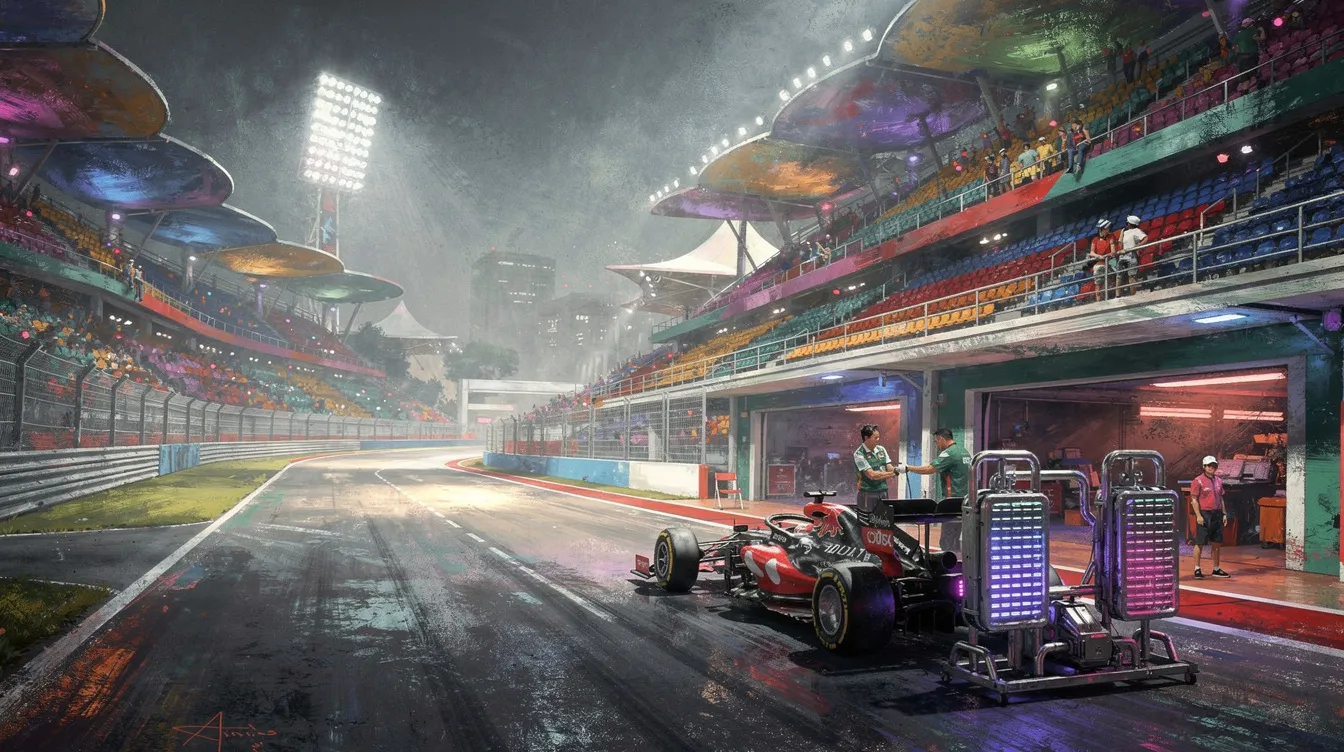
SINGAPORE – The International Automobile Federation (FIA) has declared a heat hazard for the upcoming Singapore Airlines Singapore Grand Prix, set for October 10 for the sprint and October 11 for the main event in 2026. This marks the second consecutive year that such a declaration has been made, reflecting the extreme conditions drivers will face at the Marina Bay Street Circuit.
Race director Rui Marques announced on October 8 that the FIA's heat hazard regulations would be activated after the official weather service forecasted temperatures exceeding 31 degrees Celsius (88 degrees Fahrenheit) during the race weekend. This declaration requires teams to implement precautionary technical measures to safeguard drivers from heat exhaustion and elevated core body temperatures.
The introduction of a sprint race for the first time this year adds to the intensity of the weekend. The sprint, consisting of 21 laps, will take place on October 10, followed by the main event on October 11. The FIA's cooling system, which circulates chilled fluid through a specially designed fireproof vest worn by drivers, must be fitted to all cars. However, drivers can opt to take a ballast penalty instead of using the cooling vest, which weighs an additional 5 kg.
“Over the last few weeks, months, the preparation has been there and (we’ve had) more heat training.”Max Verstappen, Four-time World Champion
This year's event is further complicated by air quality issues, as the 24-hour Pollutant Standards Index (PSI) remains in the unhealthy range of 101 to 200 due to haze from nearby fires in Indonesia. The Singapore Tourism Board has stated that it is monitoring the situation and has prepared contingency plans to address various scenarios related to haze, including providing medical assistance and N95 masks on-site if necessary.
Despite these challenges, drivers and team officials have expressed confidence in their preparations. Four-time world champion Max Verstappen noted that while the air quality is suboptimal, the drivers are acclimatized following their recent race in Bahrain. He mentioned that the preparation has been thorough and that they have engaged in more heat training in recent weeks.
“It’s going to be a very challenging weekend for that reason. To have a sprint race on a street track is going to be quite tough for everybody.”Charles Leclerc, Ferrari Driver
Ferrari's Charles Leclerc acknowledged the difficulties posed by the conditions, noting that it would be a very challenging weekend due to the sprint race on a street track, which would be tough for everyone involved.
The FIA's heat hazard regulations were first implemented at the 2025 Singapore Grand Prix, following concerns raised after extreme conditions at the 2023 Qatar Grand Prix, where several drivers required medical attention. This year's declaration is the fourth of the 2026 season, with previous ones occurring at the United States Grand Prix, the Austrian Grand Prix, and the Italian Grand Prix in Monza.
As the race weekend approaches, teams are preparing to configure their cars and cooling systems to adapt to the demanding conditions, which are compounded by the unique challenges of a street circuit. The combination of high temperatures, humidity, and limited airflow makes Singapore one of the most physically demanding races on the Formula 1 calendar.