Philippines
Philippine National Government Debt Reaches Record P19.07 Trillion
The Philippine government's outstanding debt surged to a historic high, driven by increased domestic and external borrowings aimed at funding national development.
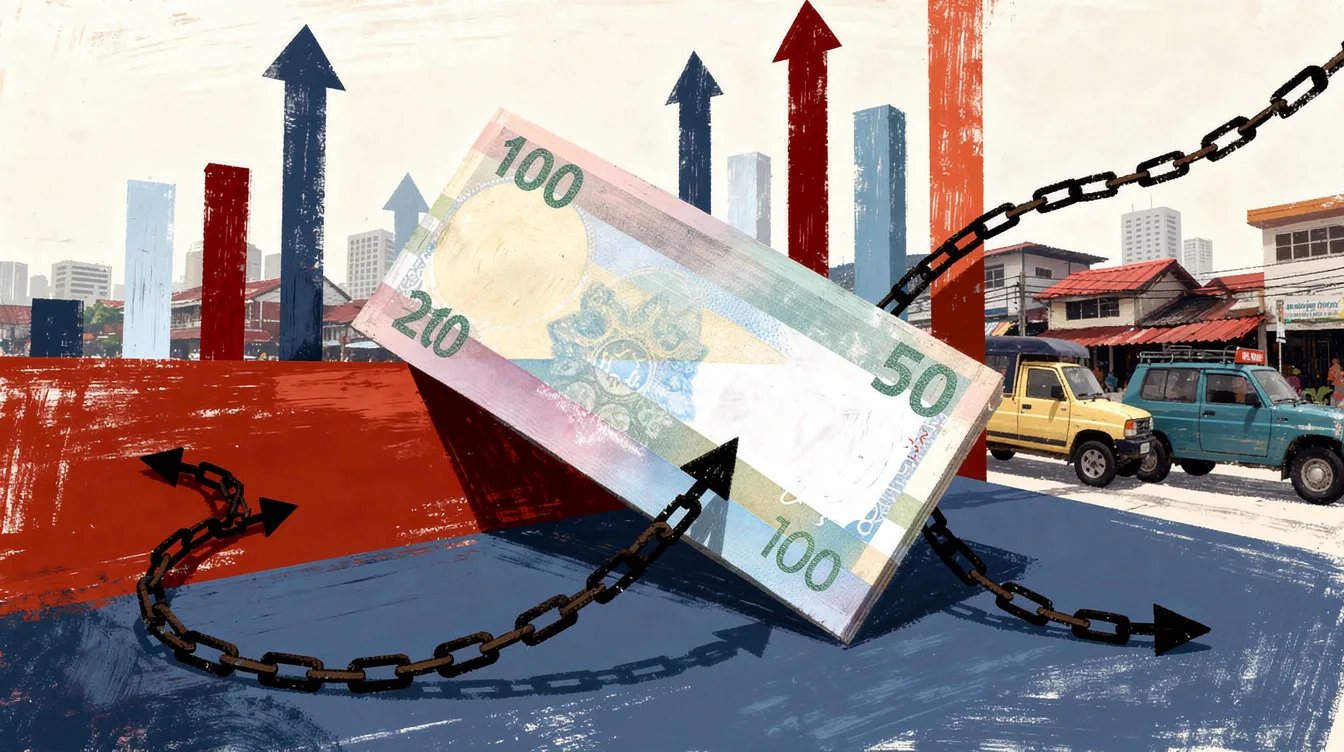
The National Government's (NG) total outstanding debt has reached a record-high of P19.07 trillion (approximately $335 billion) as of the end of June, according to the Bureau of the Treasury (BTr). This marks an increase of 2.8% from P18.55 trillion (around $318 billion) at the end of May. The rise in debt is attributed to a combination of domestic and external borrowings aimed at financing national development initiatives.
Specifically, the increase of P518.98 billion (about $9.2 billion) was largely driven by the net availment of loans and securities. The BTr noted that the peso's favorable movement against the US dollar helped temper the month-on-month increase in debt levels. By the end of June, the peso had appreciated by 21.1 centavos, closing at P61.29 (approximately $1.00) against the dollar, compared to P61.501 at the end of May.
Year-on-year, the outstanding debt has surged by 10.41% from P17.27 trillion (around $307 billion) recorded in June 2025. This current debt level also surpasses the P19.06 trillion (approximately $334 billion) projected for the end of 2026 under the national budget.
Composition of the Debt
Domestic debt constitutes the majority of the total debt stock, accounting for 67.33% or P12.84 trillion (around $221 billion), while external debt comprises the remaining 32.67% at P6.23 trillion (approximately $107 billion). The domestic obligations increased by 2.74% from P12.5 trillion (around $216 billion) in May, and by 7.43% from P11.95 trillion (approximately $208 billion) in June 2025.
The increase in domestic debt was primarily due to a net issuance of government securities amounting to P342.93 billion (about $6.1 billion), although this was partially offset by a P600 million (approximately $10,800) downward valuation adjustment on onshore dollar bonds resulting from the stronger peso.
External debt also saw a rise of 2.92% from P6.05 trillion (around $104 billion) in May, reflecting a net availment of external loans totaling P223.11 billion (approximately $4 billion). Year-on-year, external debt has increased by 17.13% from P5.32 trillion (around $92 billion) in June 2025.
Government Obligations and Future Outlook
In terms of guaranteed obligations, there was a significant decline of 31.21%, bringing the total to P305.07 billion (approximately $5.3 billion) at the end of June, down from P443.51 billion (around $7.7 billion) the previous month. This decrease is attributed to net repayments of both external and domestic guarantees, which totaled P470 million (about $8.4 million) and P136.71 billion (approximately $2.4 billion), respectively.
John Paolo R. Rivera, a Senior Research Fellow at the Philippine Institute for Development Studies, remarked that the current debt level remains manageable as long as the economy continues to grow and the government maintains fiscal consolidation. He emphasized that what matters is not just the size of the debt, but whether it is used to finance productive investments that support long-term growth and generate future revenues. Rivera anticipates that the debt stock will continue to rise in alignment with the NG's medium-term fiscal consolidation strategy.
According to the Philippine Development Plan 2023-2028, the government aims for a debt-to-GDP ratio of 60-63% by 2026. As of the first quarter of 2026, this ratio stood at 65.2%, the highest level since 2005.