Philippines
AMD Introduces Agentic AI for Local PCs: A New Era in Computing
AMD's latest Ryzen AI portfolio aims to enhance local processing capabilities, enabling more complex AI applications on personal computers.
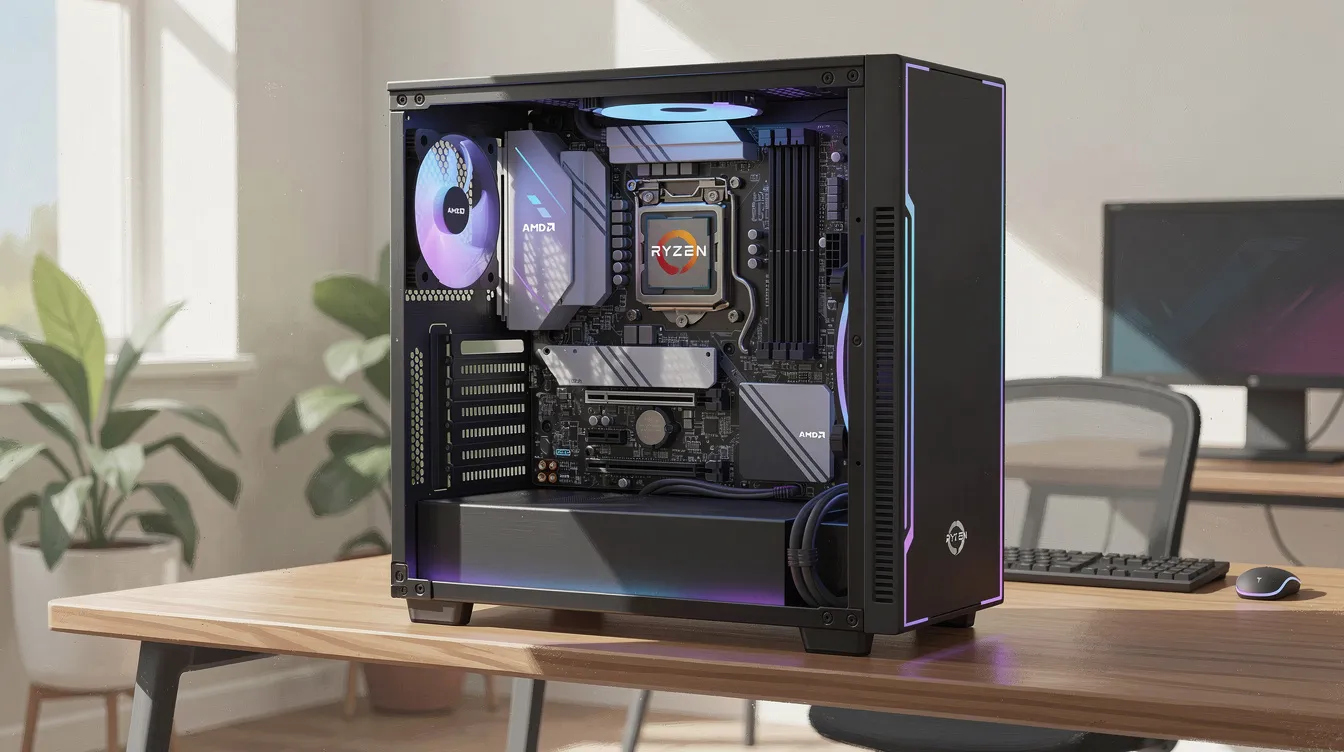
During an online briefing on September 30, AMD outlined its strategy for integrating agentic AI into personal computers, emphasizing the growing necessity for local processing in the development of advanced AI applications. Michael Nordquist, AMD's corporate vice president for client product marketing, explained that agentic computing represents a departure from traditional generative AI, as it enables systems to execute complex tasks autonomously rather than merely responding to prompts.
Nordquist stated that moving into agentic means having an agent working on one's behalf on more complex tasks where one assigns it a task or an outcome and it reasons through it. This evolution in computing requirements underscores the importance of robust CPU, GPU, NPU, and memory capacities, as these agents are designed to operate locally and repeatedly.
“As we move into agentic, that means you have an agent working on your behalf on more complex tasks where you really try to assign it a task or an outcome and actually reason through it.”Michael Nordquist, AMD Corporate Vice President for Client Product Marketing
AMD has reported shipping tens of millions of AI PCs across more than 250 designs, with agentic PCs exceeding 500,000 units across over 50 designs. The Ryzen AI Max platform, which combines a Zen 5 CPU with up to 16 cores and 32 threads, is central to this initiative. It also features up to 192GB of unified memory and RDNA 3.5 graphics, enabling the execution of large language models locally, including a 320 billion-parameter GLM 5.3 Flash model.
According to AMD, this local execution can significantly mitigate the costs associated with cloud-based AI workloads, which are typically charged based on token usage. Nordquist noted that if one is able to run everything locally, there are device and power costs, but it is almost like free tokens while still achieving quality.
“For us at Light Sail — we’re a small company, we’re a small team. In order to operate as a small team, we need to think big. We have to be really efficient.”Matthew Celia, Founder and CEO of Light Sail VR
A practical application of this technology was demonstrated through a case study involving Light Sail VR, an Emmy Award-winning production company. The firm developed an AI production coordinator powered by an AMD Ryzen AI Max processor, which streamlined administrative tasks such as managing schedules and stakeholder communications. Light Sail VR's founder, Matthew Celia, remarked that as a small company with a small team, they need to think big and be really efficient.
Despite these advancements, Nordquist emphasized that the successful implementation of agentic computing hinges on the availability of supportive software and enterprise infrastructure. AMD's offerings include a range of Ryzen AI processors, Radeon AI PRO graphics, and the Ryzen AI Halo developer platform, all of which are designed to facilitate the adoption of this technology.