Indonesia
Jakarta's Water Crisis: A Struggle for Access Amid Sinking Streets
As Jakarta aims for universal piped water access by 2029, millions still depend on costly alternatives, exacerbating the city's subsidence issues.
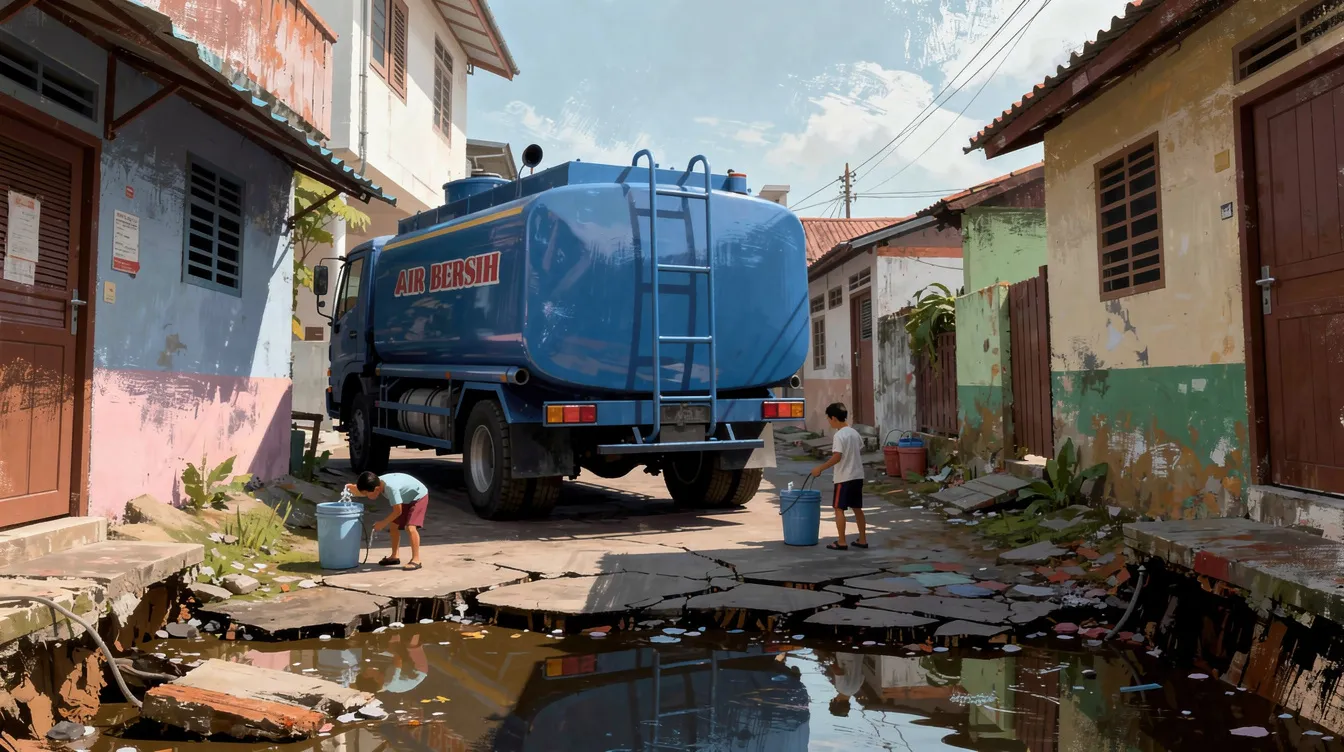
In Jakarta, one of the world's most populous cities, access to clean water remains a pressing issue for millions. Despite the public utility PAM JAYA's efforts to expand piped water access, many communities, particularly in lower-income neighborhoods, continue to rely on costly water deliveries from trucks or local vendors.
In Penjaringan, North Jakarta, families like those of Ellah, a local water kiosk operator, face significant challenges. Ellah notes that when deliveries stop, life becomes nearly impossible for her community of about 200 families. For seven days, she recounted, people couldn’t wash. They couldn’t cook. Currently, families in this area spend up to 600,000 rupiah ($33) monthly on water, which can be a substantial burden given that average household incomes range from 1.5 to 3 million rupiah ($80 to $160).
Jakarta's water crisis is intricately linked to its status as the fastest-sinking city globally, with some areas subsiding by up to 15 centimeters annually due to excessive groundwater extraction. This phenomenon has prompted the Indonesian government to consider relocating the capital to Nusantara in East Kalimantan. According to scientists, this subsidence is primarily driven by the over-extraction of groundwater, rather than rising sea levels.
“Access to water is our right as citizens, and it is the responsibility of the government to provide it.”Husnin, resident of Penjaringan
PAM JAYA has reported that since taking over the city's water system in 2023, it has increased piped water coverage from just over 60% to about 82% this year, with plans to achieve universal access by 2029. However, the utility faces significant challenges, including a high rate of water leakage—up to 50% of treated water is lost before reaching customers. This issue is exacerbated by the city's aging infrastructure, which has not kept pace with its rapid population growth.
Historically, Jakarta's water infrastructure was designed during the Dutch colonial era, primarily serving European neighborhoods and leaving many local communities without access. This legacy has resulted in a reliance on groundwater that has persisted for decades. In the 1990s, the government sought to expand water services through private operators, but many critics argue that these arrangements led to a governance void, with no single entity accountable for the water system's management.
Wahyu Kusuma Astuti, a lecturer at Universitas Tarumanagara, points out that the city's water system has been treated as a commercial opportunity rather than a public service. This perspective has hindered effective investment in infrastructure, particularly in poorer areas where families often pay the highest prices for water. According to researcher Marwa, the burden of collecting water disproportionately affects women, who often have to stay awake late into the night to fill buckets when water flows.
“Water is a human right that should be fulfilled by the state, not by profit-oriented private entities.”Muhammad Aminullah, executive director of WALHI Jakarta
Environmental organization WALHI emphasizes that simply expanding the piped network will not resolve the water crisis. Executive director Muhammad Aminullah argues that reliable service and improved water quality are essential for residents to abandon groundwater reliance. He also highlights the need for stricter regulations on commercial water users, such as hotels and industries, which extract significantly more groundwater than households.
PAM JAYA has stated that its primary goal is to expand access to safe piped water and has accelerated investments since the return of water services to public management. However, the effectiveness of these efforts remains to be seen, as many households continue to distrust the municipal water supply.
As Jakarta grapples with these challenges, the need for a comprehensive solution that addresses both infrastructure and the underlying governance issues becomes increasingly urgent. The city's future depends on breaking the cycle of groundwater dependence and ensuring that all residents have access to clean, reliable water.