Vietnam
Vietnam Attracts Billions in Semiconductor Investments from Global Giants
Major tech firms like Samsung and LG are significantly increasing their investments in Vietnam's semiconductor sector, enhancing the country's role in the global supply chain.
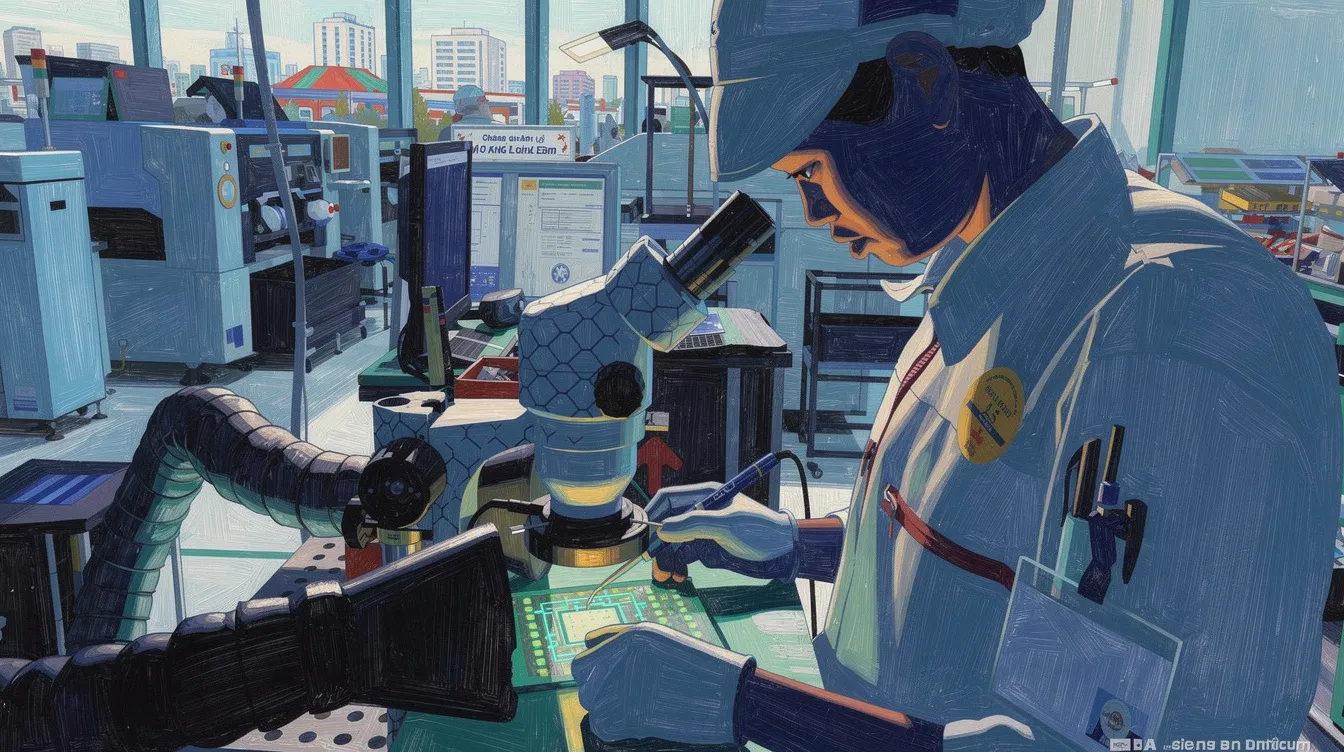
Vietnam's semiconductor industry is experiencing a substantial influx of foreign direct investment (FDI), with major global technology firms making significant commitments to expand their operations in the country. According to Thanh Niên, Samsung Group plans to invest approximately 12.26 trillion won (around 9.15 billion USD) to enhance its semiconductor production and testing capabilities, with nearly 8,000 billion won (about 6 billion USD) allocated specifically for projects in Vietnam.
This investment will be executed through Samsung Electronics and Samsung Electro-Mechanics, focusing on memory chip testing and the production of semiconductor packaging substrates for high-performance processors. The move is part of a broader strategy by Samsung to strengthen its manufacturing footprint in Vietnam, which is increasingly seen as a critical hub in the global supply chain.
In addition to Samsung, LG Innotek is also making strides in the semiconductor sector with a 1 billion USD investment to develop a new semiconductor factory in Hai Phong, further solidifying the region's status as a key player in electronics manufacturing. Intel is also shifting part of its assembly, testing, and packaging operations from Costa Rica to its facility in Ho Chi Minh City, which has a total investment of about 1.5 billion USD and is expected to create over 2,700 high-skilled jobs by 2025.
“The opening of our new office in Ho Chi Minh City reflects Infineon's belief in Vietnam's growth potential and our commitment to supporting local businesses and developing local talent.”C.S. Chua, Chairman and CEO of Infineon Technologies Asia-Pacific
As reported by Thanh Niên, BYD Electronics has increased its investment in Phu Tho by 479.8 million USD, adding to its previously registered capital of 269 million USD for producing electronic devices, tablets, and smart equipment.
Moreover, Infineon Technologies, a leading German semiconductor solutions provider, has opened a new office in Ho Chi Minh City, which will serve as a center for research and development (R&D), business, and marketing activities in southern Vietnam. C.S. Chua, Chairman and CEO of Infineon Technologies Asia-Pacific, affirmed the company's confidence in Vietnam's long-term growth potential and its commitment to supporting local businesses and developing local talent.
Nguyễn Thường Lạng, an international trade expert, noted that while the influx of billions in FDI presents a chance for Vietnam to enhance its production capabilities, it also necessitates improvements in infrastructure, human resources, and industrial policy. He emphasized that technology transfer, local content ratios, and the involvement of domestic enterprises will be crucial for the long-term impact on Vietnam's economy.
Võ Xuân Vinh, Director of the Business Research Institute at the University of Economics in Ho Chi Minh City, highlighted that the trend of foreign investment moving into high-tech sectors like semiconductors has been evident, particularly following a significant resolution from the Politburo aimed at attracting a new generation of FDI. He indicated that in the context of economies restructuring supply chains and intensifying technological competition, Vietnam can leverage foreign capital to promote knowledge transfer, develop human resources, and gradually build domestic technological capabilities.
“In the context of economies restructuring supply chains and intensifying technological competition, Vietnam can leverage foreign capital to promote knowledge transfer, develop human resources, and gradually build domestic technological capabilities.”GS-TS Võ Xuân Vinh, Director, Business Research Institute, University of Economics, Ho Chi Minh City
Vinh also pointed out that attracting capital and technology from large corporations is just the first step. The challenge lies in ensuring that Vietnamese companies are not sidelined in the supply chain, as much of the essential technology, components, and supply networks are still dominated by foreign firms.
The Vietnamese government has directed foreign enterprises to actively develop the electronic ecosystem in Vietnam, expand their lists of local suppliers, share quality management standards, and train local personnel to enable deeper participation in the supply chain. This approach aims to foster a more integrated and self-sufficient industrial environment.
As Vietnam continues to enhance its role in the semiconductor industry, the government is also focusing on linking imports with local production and export, ensuring that imported materials and equipment are effectively utilized to create production capacity and added value within the country. Key areas for innovation and technology mastery include microchip design, semiconductor packaging and testing, electronic components, automation, artificial intelligence, and data center equipment.