The voice of the ASEAN people

INSIDE·ASEAN

Connecting ASEAN with the World

The Explainer · World Cup 2026

The Passport XI

Africa's World Cup surge is built on players with two passports. Most of Southeast Asia makes its diaspora choose one — and its strongest teams exist only on paper. A story about football, citizenship law, and the price of a closed door.

scroll ↓
01 — Two countries, one July

The half-million-person nation still playing, and the 280-million-person nation watching

A record ten African teams came to this World Cup. Nine reached the knockout rounds. And much of their firepower was born in Europe.

On the fourth of July, in Miami, the world champions needed 120 minutes and an own goal to shake off a nation of half a million people. Cape Verde — at its first World Cup, unbeaten through a group containing Spain and Uruguay — finally fell 3–2 to Argentina in extra time, with a squad drawn from fourteen countries, six of its players born in the Netherlands, four in Portugal, and one centre-back famously scouted over LinkedIn from a club in Dublin. Three days earlier, Morocco had beaten Canada 3–0 to become the first African side ever to reach back-to-back World Cup quarter-finals; on Thursday in Boston it plays France — a rematch of the 2022 semi-final, against the country where six of its own squad were born. Egypt, unbeaten, faces Argentina as this piece goes to press.

Meanwhile, the world's fourth-most-populous country watched the group stage from the sofa. Indonesia came closer to a World Cup than at any time since it played as the Dutch East Indies in 1938 — with a squad rebuilt around Dutch-born players who gave up their EU citizenship to play, because Indonesian law gave them no other way in. The heritage stars who stayed in Europe went on to play for someone else, or for no one at all.

The difference between those two stories is not talent. It is paperwork. This is a story about the single most under-rated instrument in international football: citizenship law.

9%

In 2006, fewer than one World Cup player in eleven was born outside the country he represented.

16.5%

By Qatar 2022 the share had broken out of its historical 8–12% band — Morocco reached the semi-final with 14 of 26 players born abroad.

~23%

At this World Cup nearly one in four players was born abroad. DR Congo's squad counts 20 of 26; Morocco's, 19. The passports made the pipeline possible.


02 — The rule that picks the team

FIFA doesn't check your blood. It checks your passport.

To play for a national team, FIFA's statutes require one thing above all: the player must hold the nationality of the country — the passport, not the ancestry. Heritage gives a player a claim: birth on the territory, a parent or a grandparent born there, or years of residence. Only citizenship law converts that claim into eligibility. And since FIFA's September 2020 reforms, even a player already capped by one country can switch to another — if he was under 21 at his last appearance, played no more than three senior matches, and sat out three years. The window for changing shirts has never been wider. What decides who climbs through it is not FIFA. It is each country's citizenship act.

Team selection begins not with a coach's squad list, but with a parliament's citizenship act.

That is why two countries with equally vast, football-mad diasporas can field utterly different teams. A country that permits dual citizenship lets a Rotterdam-born winger play for it at no personal cost — he keeps his EU passport, his club career, his children's options. A country that bans dual citizenship asks the same winger to surrender all of that for a shirt. Some say yes. Most say no.

Who can play for whom — the rules in one panel

Three gates decide, and a player must pass every one that applies. The first is FIFA's; the second belongs to parliaments; the third only matters if he has already worn another shirt.

Gate 1 · FIFA
The claim — a "genuine link"
  • Born on the country's territory
  • A biological parent born there
  • A grandparent born there
  • Residence: 3 years if he moved before age 10; 5 years otherwise
  • A great-grandparent — one generation too far
  • FIFA eligibility rules (Arts. 6–8 of the 2024 statutes)
Gate 2 · Parliament
The passport — he must actually hold it
  • Dual citizenship allowed → the claim costs nothing: keep both lives (Morocco, the Philippines, Thailand)
  • Dual citizenship banned → he must renounce the other passport to take this one (Indonesia, Malaysia, Singapore)
  • Ancestry is never enough on its own: no passport, no shirt
Gate 3 · The switch
Already capped? The 2020 escape hatch
  • Youth caps never tie a player — only senior ones do
  • Even a capped senior can switch once, if: he held the new nationality at his first match, was under 21 at his last, played ≤3 senior matches, 3 years have passed…
  • …and he has never played at a World Cup or continental final tournament
  • Art. 9 (now 10), as amended Sept 2020
Achraf Hakimi → MoroccoBorn Madrid to Moroccan parents. Gate 1: parent ✓. Gate 2: Morocco allows dual — he keeps his Spanish life. Gate 3: never capped by Spain.plays, at zero cost
Pascal Struijk → Indonesia?Grandparents born in the Dutch East Indies: Gate 1 ✓. Gate 3 ✓ (no senior caps). But Gate 2: Indonesia requires surrendering his EU passport.eligible — if he goes all-in
Ryan Flamingo → Indonesia?Heritage via a great-grandparent. Fails Gate 1 — FIFA's line stops at grandparents. No citizenship reform can fix this.never eligible
Tijjani Reijnders → Indonesia?Moluccan mother: Gate 1 ✓. But he chose the Netherlands and has played far past Gate 3's limits.cap-tied for good
Simplified; the full conditions are in FIFA's eligibility commentary — see references.

03 — Africa's open door

How Africa turned emigration into a talent pipeline

The template was drawn in Qatar. Morocco's 2022 semi-finalists — the first African or Arab team ever to go that far — counted 14 of 26 players born abroad: in Spain, France, the Netherlands, Belgium, Italy and Canada. When journalists needled coach Walid Regragui about fielding players born in Europe, his answer after knocking out Spain became the movement's manifesto.

"Today we have shown that every Moroccan is Moroccan… I fight to make it not about nationality, to make it not about passports."
— Walid Regragui, Morocco coach, December 2022

None of it was an accident. Morocco's federation ran full-time scouts in the Netherlands, Germany, France, Spain and Scandinavia, keeping a database of every Morocco-eligible dual-national and reaching them before their birth countries could cap them — while a royal academy built the home-grown spine. Cape Verde, whose diaspora outnumbers its resident population, went further: its captain-material centre-back Roberto Lopes was famously recruited over LinkedIn from a Dublin club. In 2026 the model has only deepened — Morocco fielded what is reported as the first all-foreign-born starting XI in World Cup history, and the France federation's own technical director conceded, of the Lille teenager Ayyoub Bouaddi who chose Morocco this spring: "We lost a unique talent… but it was his choice."

The legal foundation everywhere is the same: these countries let their diaspora keep both passports. A boy born in Utrecht to Cape Verdean parents is Cape Verdean for life if he wants to be — at no cost to his Dutch life. The passport does not compete with his future. It travels with it.

Born abroad, playing for home

Foreign-born players in African squads at the 2026 World Cup (of 26-man squads).

Media tallies of the official 26-man squad lists (Flashscore; Bolavip; Front Office Sports). CIES had not published a 2026 birthplace census at press time. Egypt: 1. South Africa: 0 — one of only eight fully home-born squads at the tournament.

A century of moving boots

Share of World Cup players born outside the country they represent, 1930 → 2026.

For most of a century the share fluctuated in a rough 8–12% band (Oonk, 2020) — then came the 2020 eligibility reforms and the diaspora era. 1930–2018: van Campenhout, van Sterkenburg & Oonk (10,137 player-cases); 2022: Migration Policy Institute; 2026: Foreign Policy / COMPAS-Oxford (289 of 1,248).

04 — Southeast Asia's locked door

One region, ten rulebooks — most of them closed

Southeast Asia has diasporas to rival Africa's: centuries of migration to the Netherlands, millions of Filipinos abroad, Vietnamese communities across France, Germany, the Czech Republic and the US. What it mostly lacks is the legal plumbing to use them. The majority of ASEAN states do not permit adult dual citizenship.

Who lets you keep both passports?

Adult dual-citizenship rules across ASEAN — the quiet team-sheet law.

Simplified; nuances in the text and references. Sources: national citizenship statutes — see references.

The consequences map neatly onto the table. The Philippines, the region's one long-standing open door, built its national team on the diaspora two decades ago — the Azkals of the Younghusband era, then Neil Etheridge becoming the first Southeast Asian to play in the Premier League. Nine of eleven starters in one World Cup qualifier were foreign-born. Thailand, tolerant of dual nationality since 1992, quietly fields a Ligue 1 winger and a 2. Bundesliga right-back without asking anyone to give anything up. Vietnam spent a decade making its Việt kiều wait — goalkeeper Filip Nguyễn's citizenship took nearly ten years — then pivoted hard: a July 2025 law lets naturalising talent keep a foreign passport with presidential approval, sports named explicitly.

And then there is Indonesia, which chose the hardest path: recruit the diaspora and keep the single-citizenship rule. Every Dutch-born player who joined its programme — sixteen and counting since 2022 — had to renounce his European citizenship at the DPR's door. Singapore enforces its ban hardest of all: when Cardiff City's Perry Ng, a Singaporean grandfather on his papers, applied through the revived Foreign Talent Scheme, the price quoted was his British passport. As the Home Affairs ministry once put it, a second citizenship "could dilute" commitment — roughly 1,600 adults a year renounce or are stripped.


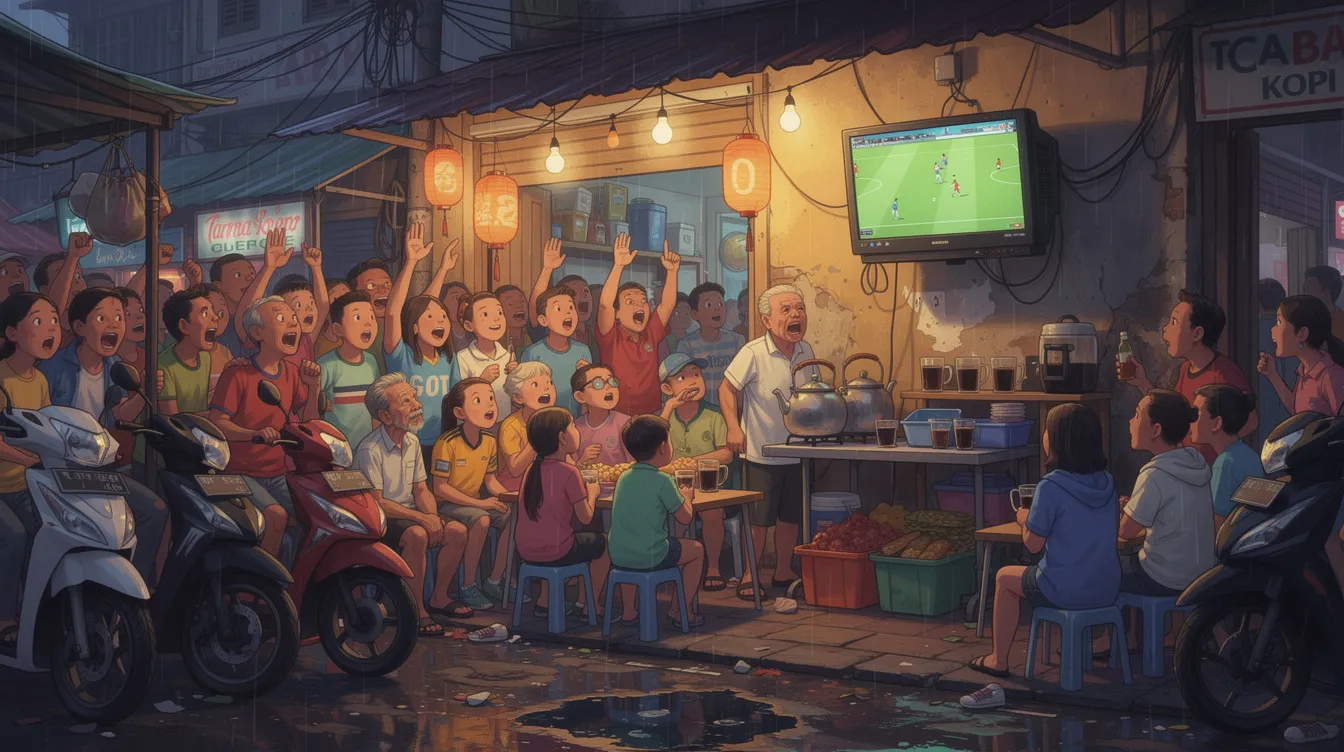
A crowd of fans watching a football match on a small TV at a Southeast Asian street-side coffee shop at night.
Illustration — match night at the warung kopi. Indonesia's World Cup dream is watched, for now, from the street.
05 — The near miss

Indonesia: the team that almost made it — minus the ones who wouldn't sign the form

On a November night in 2024, Marselino Ferdinan scored twice at a heaving Gelora Bung Karno and Indonesia beat Saudi Arabia for the first time in its history. The team that did it was the product of the most audacious talent project in Asian football: under PSSI chairman Erick Thohir, Indonesia naturalised around twenty European-born players of Indonesian descent in three years — vetted by parliament, signed off by presidential decree, sworn in at ministry offices and embassies. Against Japan in qualifying, nine of the starting eleven had Dutch heritage. The captain, Jay Idzes, leads Sassuolo in Serie A; Kevin Diks became the first Indonesian in the Bundesliga; Calvin Verdonk the first in Ligue 1; Maarten Paes keeps goal for Ajax.

And each of them paid the entry fee: because Indonesia bans adult dual citizenship — and Dutch law strips citizenship from adults who voluntarily take another — every oath meant surrendering an EU passport for good. The bill for that came due this spring, in what Dutch media called Passportgate: roughly 25 naturalised players in Dutch football were abruptly suspended when a rival club pointed out that, as non-EU citizens now, several no longer met the Eredivisie's work-permit salary floor. They were cleared weeks later through residence permits — but the episode showed, in the coldest administrative terms, exactly what the shirt had cost.

It also explains the ceiling. The programme's decliners — Manchester City's Tijjani Reijnders, whose Moluccan-descent brother Eliano did switch; Stoke's Million Manhoef; Fenerbahçe's Jayden Oosterwolde, who says Vietnam-style monthly calls still come — all cite the dream of playing for the Netherlands. None has said publicly that the passport was the reason. But a rule that prices a fallback career in Europe into every refusal stacks the odds: a Moroccan prospect never has to choose; an Indonesian one must go all-in. Indonesia still finished within touching distance — the deepest qualifying run in its history, ended in Jeddah in October 2025 by a 3–2 to Saudi Arabia and a single Zidane Iqbal goal for Iraq: the two teams that took Asia's last tickets to this World Cup. Patrick Kluivert left within a week; John Herdman now holds the project. The margin, both nights, was one goal.


06 — The cautionary tale

When the shortcut becomes a scandal

If Indonesia shows the cost of doing heritage recruitment by the book, Malaysia showed what happens off it. In September 2025 FIFA found that the Football Association of Malaysia had submitted forged ancestry documents for seven foreign-born players — grandparents' birth certificates relocating births from Argentina, Brazil, Spain and the Netherlands to Penang, Malacca, Johor and Kuching. The forgeries were almost comic: one "grandmother's" certificate listed her sex as male; another misspelled Kuching. All seven had played in a 4–0 qualifying win over Vietnam. FIFA fined the FAM CHF 350,000 and banned the players for twelve months; the Court of Arbitration for Sport upheld the findings in March 2026; the Asian confederation then turned two Malaysian wins into 0–3 forfeits — sending Vietnam, the wronged opponent, to the 2027 Asian Cup in Malaysia's place. The FAM's entire executive committee resigned en masse. The national team fell to its lowest world ranking in two decades. Thailand's football chief, Madam Pang, drew the moral pointedly: Thailand would field only players "with genuine ancestry."

The scandal sharpened a debate that runs through every football federation with a diaspora: at what point does a national team stop representing the nation? Fans in Jakarta have asked whether their team is becoming a "KNVB B side"; fans in Rabat asked the same about France, until the trophies started arriving. The tension is real — pleasing the citizens you have versus fielding the strongest team your bloodlines allow — and it is the exact tension every ASEAN government faces on dual citizenship generally, with jobs and investment in place of goals.


07 — The what-if machine

The teams that exist only on paper

What would ASEAN sides look like if any professional with verified heritage could pull on the shirt — without surrendering a passport to do it? Below, our best-effort XIs. Toggle between what the law allows today and the open-passport XI. Every player is tagged with his club and heritage line; this is an editorial estimate, not a FIFA squad list.

The Diaspora XI

Tap a shirt for the player's club and heritage. Toggle the passport rule.

plays / could play now blocked or lost under current law cap-tied elsewhere — the one that got away

Editorial estimate. Heritage lines individually sourced; see references. Clubs as of mid-2026 where verified.

How far could these paper teams go? Honest answer, with the caveats attached: these are editorial estimates, since no federation has simulated them. The Philippines came closest to running the experiment — its diaspora side went unbeaten through the last Asian Cup qualifying round and missed the tournament on a tiebreaker; with Areola it would be a fixture at that level. Indonesia's open-passport XI — Tijjani Reijnders conducting from midfield in front of an Idzes–Struijk pairing, Manhoef wide of Romeny — is on paper the strongest team Southeast Asia has ever produced, plausibly a genuine World Cup-qualification side given how close the actual team came without them. Vietnam's pool upgrades its spine but is thinnest where Asia punishes you: no heritage striker at professional level. Thailand's XI already plays — its ceiling is talent development, not law. And Malaysia's genuine pool, stripped of the forged seven, is the region's cautionary median: solid, Cools-anchored, and structurally missing a goalkeeper.


Split illustration: a young footballer training alone in a rainy European city on the left, children playing on a village pitch in Southeast Asia on the right, joined by a single pitch line.
Illustration — one pitch line, two worlds. The diaspora question is where they meet.
08 — Beyond football

The dual-citizenship question is never really about football

Football merely makes visible, in ninety minutes, what economists measure over decades. A diaspora is a standing stock of skills, capital, networks and — yes — athletes. Countries that stay connected to it draw those assets home; countries that force a choice mostly lose them. The academic literature on dual citizenship shows a steady global drift toward tolerance — a majority of the world's states now accept it — with Southeast Asia among the holdouts.

The research is unusually one-directional. Maarten Vink and colleagues, tracking every state since 1960, found dual-citizenship acceptance has spread from one-third of countries to three-quarters — states liberalise when their neighbours do, and when remittances matter. The World Bank counted US$685 billion in remittances to lower- and middle-income countries in 2024 — more than foreign direct investment and aid combined, with the Philippines' roughly $40 billion the region's largest. The "diaspora option" literature, from Meyer's expatriate knowledge networks to Saxenian's brain circulation, reaches the same conclusion football did: emigrants are not a loss to be written off but a stock of skills to stay connected to — if the law lets you.

Indonesia knows this; the argument is live in Jakarta right now. A Global Citizen Indonesia scheme launched in January 2026 — a lifetime visa for former citizens, modelled on India's OCI card — was dismissed by diaspora groups as a half-measure. A revision of the citizenship law is before the DPR that would create "certain dual citizenship" for people of strategic value, with sports named explicitly; the law minister has said he wants it finished this year. Scholars of Indonesian citizenship have long sketched the compromise — Bilal Dewansyah calls it "semi-dual citizenship". Vietnam, meanwhile, simply did it: its July 2025 law lets naturalising talent keep a foreign passport with presidential approval. The region's locked doors are starting to creak.

If this argument sounds familiar, it should: it is the same architecture as the region's foreign-investment debate — openness as the growth default, gated by fears about loyalty and control. We mapped that story in The Open Door. The passport question is the human sequel.

09 — The verdict

Talent doesn't emigrate. It multiplies — if the law lets it come home.

Africa's World Cup taught a simple lesson: a diaspora is not a loss ledger. The players who left, or whose parents left, came back better — trained in Europe's academies at Europe's expense, and eligible because their home states never made them choose. Southeast Asia's federations have the same bloodlines and none of the plumbing.

The strongest teams in ASEAN's history already exist. They're just illegal.

There are real arguments on the other side — sovereignty, loyalty, the queue of local players who stayed. The honest reading of the evidence is the same as for capital: openness with conditions beats a closed door. A country need not sell full dual citizenship tomorrow; a heritage-athlete provision, a diaspora status with civic rights, or simple recognition of dual nationality to a defined degree would do most of the work football needs — and would signal something much larger to the millions abroad who still call it home.

Sources & further reading

References

  1. van Campenhout, G., van Sterkenburg, J. & Oonk, G. (2018). "Who Counts as a Migrant Footballer?" Int. Journal of the History of Sport 35(11); and (2019) "Has the World Cup become more migratory?" Comparative Migration Studies 7:22. doi
  2. Oonk, G. (2020). "Who May Represent the Country? Football, Citizenship, Migration, and National Identity at the FIFA World Cup." Int. Journal of the History of Sport 37(11) — the 8–12% historical band. pdf
  3. Vink, M., Schakel, A., Reichel, D., Luk, N.C. & de Groot, G-R. (2019). "The international diffusion of expatriate dual citizenship." Migration Studies 7(3) — one-third to three-quarters of states. doi
  4. Harijanti, S.D. (2017). Report on Citizenship Law: Indonesia; Low, C.C. (2017). Report on Citizenship Law: Malaysia and Singapore — GLOBALCIT/EUI country reports. globalcit.eu
  5. Dewansyah, B. (2019). "Indonesian Diaspora movement and citizenship law reform: towards 'semi-dual citizenship'." Diaspora Studies 12(1).
  6. FIFA. Regulations Governing the Application of the Statutes, eligibility articles (as amended by the 70th FIFA Congress, Sept 2020) and the Jan 2021 Commentary on the Rules Governing Eligibility. pdf
  7. FIFA Disciplinary Committee, decision FDD-24394 (Football Association of Malaysia and seven players; motivated decision, 6 Oct 2025); CAS operative award, 5 Mar 2026. FIFA pdf
  8. [data] Foreign-born counts, WC 2026 squads: media tallies of FIFA squad lists — Flashscore; Bolavip (per-squad, June 2026); Front Office Sports (12 Jun 2026); Foreign Policy (24 Jun 2026, 289 of 1,248 = 23.2%). 2022: Migration Policy Institute (137 of 830).
  9. Brindle, B. & Sawyer, A. (2026). "Has migration become an ingredient of World Cup success?" COMPAS, University of Oxford / The Conversation. compas.ox.ac.uk
  10. Cherti, M. (2026). "Pride of Place: the story behind Morocco's World Cup squad." COMPAS, University of Oxford. compas.ox.ac.uk — with Regragui quotes via The National (7 Dec 2022).
  11. Jansen, J., Oonk, G. & Engbersen, G. (2018). "Nationality swapping in the Olympic field." Citizenship Studies 22(5); Andreff, W. (2001) on the "muscle drain," European Sport Management Quarterly 1(4).
  12. CIES Football Observatory (Poli, Ravenel & Besson). Football expatriates 2020–2025, Monthly Report 100 (May 2025) — incl. Indonesia as the 8th-largest destination for Brazilian expatriates. football-observatory.com
  13. Ratha, D., Plaza, S. & Kim, E.J. (2024). Remittances to low- and middle-income countries to reach $685bn. World Bank People Move. worldbank.org
  14. Meyer, J-B. & Brown, M. (1999). "Scientific Diasporas," UNESCO-MOST DP 41; Saxenian, A. (2006). The New Argonauts, Harvard UP; Kuznetsov, Y., ed. (2006). Diaspora Networks and the International Migration of Skills, World Bank.
  15. [law] Indonesia: Law No. 12/2006 on Citizenship; Vietnam: Law No. 79/2025/QH15 (in force 1 Jul 2025); Philippines: RA 9225 (2003); Malaysia: Federal Constitution Art. 24; Morocco: Nationality Code, Dahir 1-58-250 as amended 2007; Cape Verde: Nationality Act 2023/24 (descent to the fourth generation).
  16. [results] World Cup 2026 match results: FIFA match centre; Al Jazeera; ESPN; Fox Sports (July 2026). Indonesia's qualifying: AFC; ESPN; ANTARA (Oct 2025). "Passportgate": ESPN; Flashscore; DutchNews (Mar–Apr 2026).

An InsideASEAN explainer, published mid-tournament (7 July 2026); results current to press time. Hypothetical line-ups are editorial estimates built on individually sourced heritage claims — they are not endorsements by any federation, and players' choices are theirs alone. Where a heritage or squad figure rests on a single source, the text says so.