Cambodia
Cambodia's Shift to Local Processing: Opportunities in Agriculture and Manufacturing
As Cambodia seeks to enhance its agricultural processing and manufacturing capabilities, new investments and policies aim to keep more value within the country.
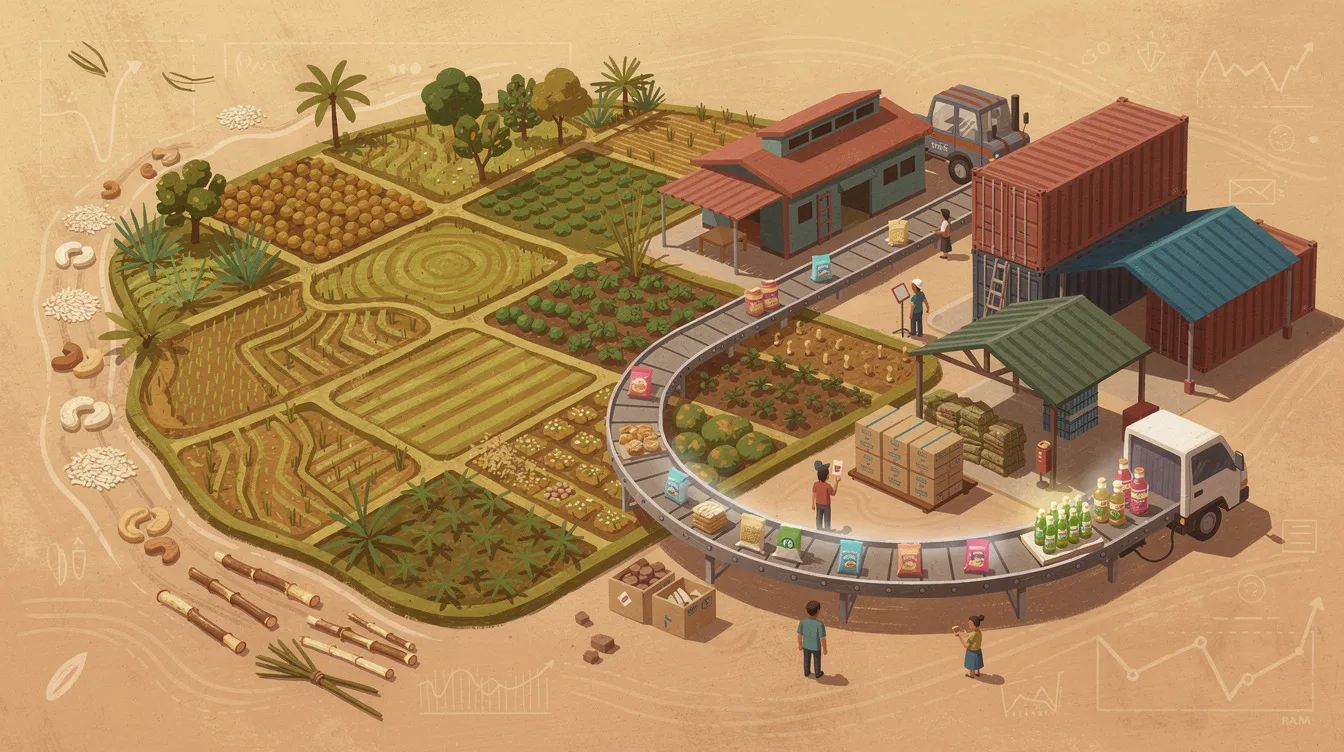
Cambodia is undergoing a significant transformation in its agricultural and manufacturing sectors, with a focus on local processing to retain value that has traditionally crossed its borders. Each year, trucks laden with raw cashew nuts queue at crossings to Vietnam, where they are shelled and processed for global markets. In 2025, Cambodia harvested approximately 1.02 million tonnes of raw cashew nuts, generating around $1.5 billion in exports, nearly all to Vietnam. Vietnam then exported processed cashews worth a record $5.2 billion, a figure that includes nuts sourced from Africa as well as Cambodia.
The Cambodian government has recognized the need to shift from exporting raw materials to developing local processing capabilities. Prime Minister Hun Sen emphasized the importance of this transition during the opening of new processing facilities, indicating that Cambodia must stop exporting raw agricultural products. As of April 2026, the country had 16 cassava processing factories, up from seven in 2020, and new investments in the sector are on the rise.
“Prime Minister Hun Sen emphasized that Cambodia must stop exporting raw agricultural products.”Hun Sen, Prime Minister of Cambodia
Logistics improvements, such as the opening of Techo International Airport in September 2025, have also played a crucial role in this shift. The airport, equipped with a dedicated cargo terminal, has facilitated quicker access for exporters, allowing local processors to reach international markets more efficiently.
Despite these advancements, challenges remain. In 2025, more than 98% of Cambodia's cashew harvest was still exported raw, largely due to competition from Vietnamese buyers who offer immediate cash payments, making it difficult for local processors to compete. Analysts have noted that local processing will require better access to working capital, improved storage facilities, and a skilled workforce to succeed.
“Analysts have noted that local processing will require better access to working capital, improved storage facilities, and a skilled workforce.”Industry analysts
In addition to agriculture, Cambodia's manufacturing sector is diversifying beyond its traditional garment base. By July 2026, the country had over 3,357 factories employing more than 1.35 million workers, with merchandise exports reaching $27.47 billion in the first nine months of the year, reflecting an 18% increase year-on-year. New investments are flowing into sectors such as electronics, automotive components, and agro-processing, supported by the government's push for industrial upgrading and regional trade integration.
Experts note that Cambodia's manufacturing capabilities are still concentrated in specific sectors, making it essential for international manufacturers to establish reliable supply chains. The Council for the Development of Cambodia reported the approval of 276 investment projects worth $4.7 billion in the first half of 2026, indicating strong interest in higher-value sectors.