Analysis · Vietnam
The Handbags Go to Auction: Trương Mỹ Lan and the Emptiest Bank in Asia
A jailed billionaire's Birkin bags are up for sale in Ho Chi Minh City. They will not cover a thousandth of what vanished. How a cosmetics seller from Chợ Lớn came to secretly own a bank — and drain it — is the largest financial fraud in history, and a parable about Vietnam's boom.
Between early 2019 and the autumn of 2022, a driver named Bùi Văn Dũng made the same delivery, over and over. He would collect boxes of cash from a branch of Saigon Joint Stock Commercial Bank — SCB — load them into his vehicle, and drive them to an apartment at 127 Pasteur Street, in District 3 of Ho Chi Minh City, where a housekeeper took them inside. He wrote down each run in a personal notebook, the way a careful man keeps his accounts.
By the time investigators found the notebook, it recorded more than 108 trillion đồng — over four billion US dollars — carried out of the bank one boxed load at a time. The bank never reported the money missing, because the woman it was going to already controlled the bank. She simply was not allowed to.
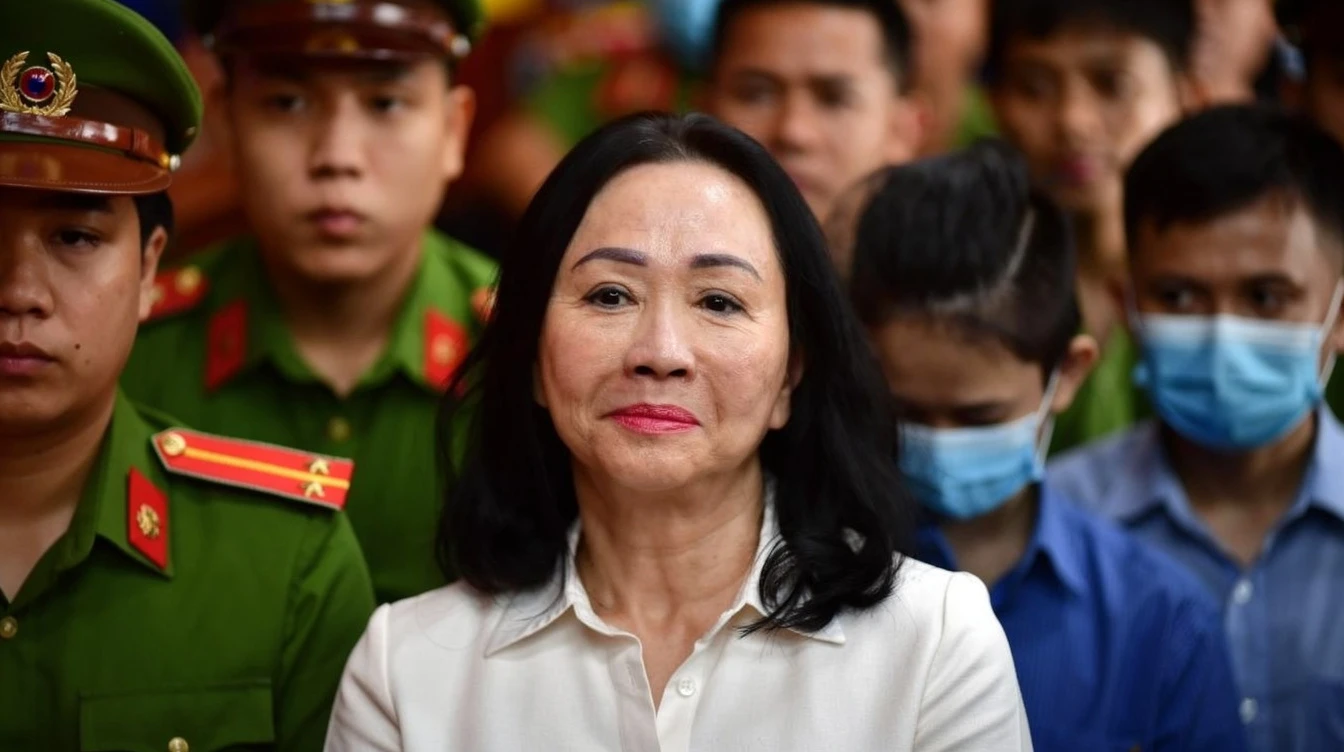
Her name is Trương Mỹ Lan, and this June a Ho Chi Minh City auction house began cataloguing her handbags: rows of Hermès Birkins and Kellys, the collection of a jailed billionaire, to be sold toward the debt she owes. It is a strange and futile spectacle. Even a wall of Birkins does not scratch the number attached to her name.
That number is around $27 billion — roughly six per cent of everything Vietnam produces in a year, and, by most reckonings, the largest financial fraud in history. The remarkable thing is not the scale. It is how quietly it was done: for a decade, one woman secretly owned a bank and drained it through a side door, while its published numbers stayed healthy.
From Bến Thành to the empire
She began at a market stall. Born in 1956 into Chợ Lớn's ethnic-Chinese Hoa community — the merchant world of Saigon's Chinatown — Lan sold cosmetics beside her mother at Bến Thành, the old covered market at the city's heart. Every profile starts here, and it is worth pausing on: the humble origin that makes the later empire feel earned, and quietly disarms the questions that should have been asked.
The turn came with Đổi Mới, the 1986 reforms that cracked open private enterprise, and with a marriage. In 1992, as Vietnam opened to outside money, she wed Eric Chu Nạp Kee, a Hong Kong investor, and together they grew Vạn Thịnh Phát into a property dynasty — hotels, restaurants, and then the crown jewels: some of the most valuable land in Ho Chi Minh City. By the 2010s she was, by wealth if not by any official ranking, among the richest people in the country.
The bank behind the proxies
Vietnamese law lets an individual own no more than five per cent of a bank. Trương Mỹ Lan owned, prosecutors established, roughly ninety per cent of SCB — one of the nation's largest lenders — held invisibly through more than two dozen proxies and shell shareholders. On paper she was barely there. In practice, the bank was a room in her house, and Bùi Văn Dũng knew the way.
What she did with it was industrial. Over roughly a decade, Bloomberg reconstructed, SCB was steered to pour loans into a lattice of shell companies she controlled — thousands of them, propped on inflated or fictional collateral. At the peak, more than nine in ten of the bank's loans flowed to her own network. The institution had stopped gathering deposits to lend to the economy and had become a pump, with the water running one way.
To keep the central bank's inspectors from noticing the hole, a $5.2 million bribe was delivered to the head of the inspection team, carried into her office in styrofoam boxes. It remains the largest bribe ever recorded in Vietnam. For years, the auditors saw a functioning bank and the rating agencies saw healthy books, while the notebook filled up and the boxes kept moving to Pasteur Street.
The furnace reaches her
What stopped the machine came from above. Since 2016, Vietnam's late Communist Party chief Nguyễn Phú Trọng had waged an anti-corruption drive he called đốt lò — the “blazing furnace,” the idea being that once the fire is hot enough, even damp logs must burn: no one, however senior, is spared. Over the years it has disciplined or jailed some 200,000 party members, felled ministers and even a state president. In October 2022, the furnace reached Vạn Thịnh Phát, and Trương Mỹ Lan was arrested.
What followed was two trials, split because the crime was too large for one. In April 2024, the first court sentenced her to death — for embezzlement, bribery and banking violations, the appropriated sum put at $12.5 billion, nearly three per cent of GDP by itself. It was the harshest sentence the campaign had produced, and it was meant to be read as a signal.
Six months later came the second trial: a life sentence, this time for defrauding around 36,000 ordinary bondholders of some $1.2 billion through illegally issued bonds, for laundering money on a vast scale, and for moving billions across the border. Those bondholders were savers, many of them elderly, who had trusted a bank. Some came to the courthouse to demand their money. They will mostly not get it.
The law rewrites itself
Then the story did something almost no fraud story does: the state changed the law around it.
On appeal, the death sentence was upheld — with an unusual escape clause. If Lan repaid three-quarters of what she took, roughly $9 billion, execution could become life. Selling every asset she owned — the towers, the land, the handbags — would not reach it. Then, in 2025, Vietnam's National Assembly abolished the death penalty for embezzlement and seven other offences. Her sentence converted to life; a separate money-laundering term was cut to thirty years on appeal. A country had, in effect, adjusted its ultimate punishment with one defendant in view.
You can read that as mercy, or as legal modernisation catching up with the world. You can also read it as the system concluding that a dead symbol recovers nothing, while a live prisoner might yet repay.
What it says about the boom
Here is the uncomfortable part for anyone bullish on Vietnam, and we are, on balance, bullish.
Vạn Thịnh Phát is not the story of one greedy woman. During the fastest stretch of Vietnam's ascent, one of its largest banks could stand hollow for years while regulators, auditors and rating agencies studied numbers that looked fine. The boom and the fraud grew in the same soil: cheap credit, a property mania, and a supervisory apparatus that could be bought for a few styrofoam boxes.
The furnace is the state's answer, and a real one — the message that no tycoon is untouchable has value. But it runs both ways. We argued, in our reading of Vietnam's race to double-digit growth, that what investors now crave is not speed but certainty — audited numbers, predictable courts, a unicorn that is load-bearing. A campaign that can jail a president reassures on one axis and unsettles on another: when enforcement moves this hard and this suddenly, the rules themselves start to feel like weather. It is the same anxiety we traced next door in Indonesia's wait-and-see capital — the sense that the scarce thing across the region is not money but trust.
The handbags
Which returns us to the auction house, and the Birkins under their lights.
There is something almost honest about the spectacle: the state selling a fraudster's luxuries, one lot at a time, in public, recovering pennies against a debt in the tens of billions. It admits, correctly, that the money is gone. Trương Mỹ Lan will spend the rest of her life in prison. The savers will be repaid in fractions. And Vietnam will keep growing, because the country underneath is real even when the number on top was a fiction.
The bank turned out to be the empty part. The harder question is how much trust drained out with the cash on its way to Pasteur Street — and how long that takes to refill, because no auction sells it back.
This account draws on court testimony and reporting by VnExpress, Bloomberg, the South China Morning Post, Al Jazeera, The Diplomat, NBC News, CBS News and CNN, each linked above; figures were sourced and verified independently against primary reporting, and any errors are our own. See also our companion pieces on Vietnam's growth target and Indonesia's wait-and-see capital.