Laos
New DNA Research Aims to Unravel Mysteries of Laos' Plain of Jars
Archaeologists are investigating ancient burial practices at the UNESCO World Heritage Site, seeking to uncover the identities and origins of those buried in the stone jars.
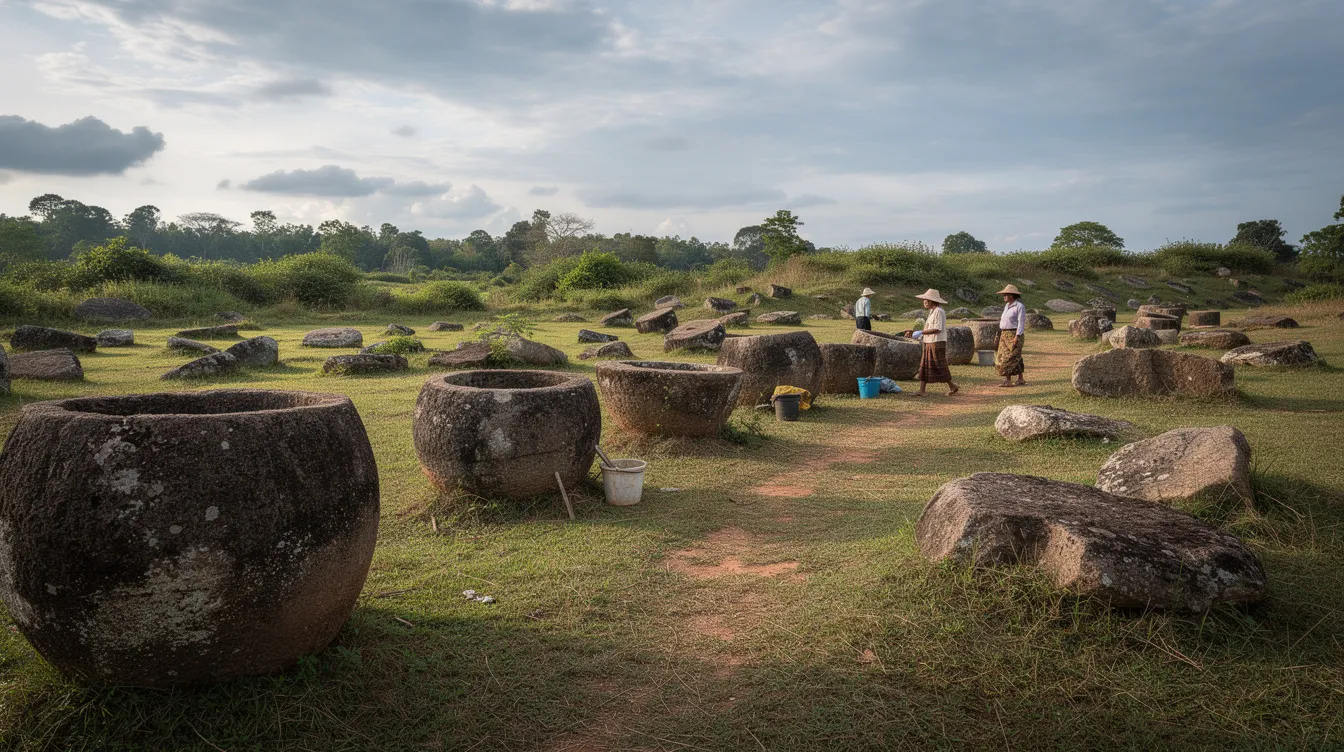
The Plain of Jars, known as Thong Hai Hin in Lao, is at the center of a significant archaeological investigation that may soon solve one of Laos' enduring mysteries: the identities of those buried within its ancient stone jars. This site, located in Xieng Khouang Province and designated a UNESCO World Heritage Site in July 2019, has long fascinated researchers and tourists alike.
Recent excavations conducted between 2022 and 2024 have focused on 'Jar 1' of the site, where archaeologists uncovered the remains of at least 37 individuals. These findings, reported by National Geographic on July 31, indicate that the burial customs of these ancient communities were complex and involved careful placement of remains, with larger bones and skulls arranged along the edges of the jars. This suggests that families may have reused the jars for generations, a practice indicative of deep cultural traditions.
“The careful arrangement of bones suggests that ancient people had careful, complex burial customs.”National Geographic
Radiocarbon dating has revealed that the jars were in use between approximately AD 890 and 1160, indicating a long period of significance for these burial sites. Scientists are now turning their attention to extracting DNA from the bones to explore familial relationships and ancestral origins. However, recovering DNA in the hot and humid conditions of Laos presents challenges, as heat and moisture can degrade genetic material over time.
“If the DNA extraction is successful, it could provide the clearest answer yet to one of Laos’ most famous mysteries.”National Geographic
In addition to human remains, archaeologists also discovered artifacts such as an iron knife, a small copper bell, pottery fragments, and glass beads within the jar. Chemical analyses of these beads suggest trade connections with regions as far as South Asia and the Middle East, highlighting the Plain of Jars as a site of broader regional exchange networks.
As researchers delve deeper into the mysteries of the Plain of Jars, the potential to uncover the identities and stories of these ancient peoples offers a unique glimpse into Laos' rich historical tapestry. The ongoing work not only aims to answer questions about who these individuals were but also to shed light on their cultural practices and interactions with surrounding regions.