Analysis · Indonesia
The Feeder Was Real. The Unicorn Was Not: What eFishery Leaves Behind
This month an appeals court cut eFishery founder Gibran Huzaifah's fraud sentence from nine years to six. The verdict stands — and so does the question of how a student who once went days without eating built, and then faked, the world's first aquaculture unicorn.

A decade or so ago, as a student wandering the halls of a Tech in Asia conference in Jakarta, I remember how alike the startups all seemed. E-commerce, mostly — at one point it felt like a dozen companies were trying to turn local factory outlets into the next Amazon.
One booth was different. It felt deeply Indonesian and improbably high-tech at the same time. Everyone knows this is a country where you can grow almost anything — our soils and waters are absurdly generous — and here was a startup promising to carry one of our oldest livelihoods, fish farming, into the new era with a smart machine.
It was called eFishery. Standing there, I remember thinking: finally, one of ours, solving something real.
On 7 July, the Bandung High Court shaved three years off Gibran Huzaifah’s prison sentence — nine years down to six, though it doubled his fine to Rp2 billion. His deputy Andri Yadi’s term was cut from seven years to four. The reduction is not an exoneration: the convictions stand, for embezzlement and money laundering, for the fraud that hollowed out the company I once stared at across a conference hall.
eFishery was never Indonesia’s biggest tech story — Gojek owns that crown, and always will. But it was something rarer. Gojek proved Indonesian tech could conquer the city. eFishery was supposed to prove it could reach the ponds — the other Indonesia, where most of us actually come from. That is the story that just ended in a Bandung courtroom, and it deserves to be told properly, from the beginning.

The boy with the ponds
The beginning is genuinely remarkable, which is part of the problem.
Gibran Huzaifah grew up in Pulogadung, East Jakarta, and arrived at the Bandung Institute of Technology with close to nothing. By his alma mater’s own account, there were stretches with no pocket money, nights with nowhere to sleep, and once, three days without eating. In an aquaculture elective, a lecturer’s talk on catfish farming struck him as a way out. He rented a pond.
He was good at it. By graduation in 2012 he was running seventy-six ponds — and had learned the industry’s dirty secret at first hand: feed devours as much as seventy to ninety per cent of a fish farmer’s costs, much of it wasted by hand-scattering pellets onto dark water on guesswork and habit. So he and a friend who could write software built a machine to do it properly — a sensor-driven feeder run from a phone. In October 2013, eFishery was born.
The early years were honest graft. The Dutch impact fund Aqua-Spark wrote its first $500,000 cheque in 2015; Gibran liked to tell early interviewers he had spent the better part of a hundred days onboarding a single sceptical farmer. This is what makes the story so hard to hold in one hand: the machine was real, the problem was real, and the founder had lived the problem in a way no Silicon Valley biography could fake.
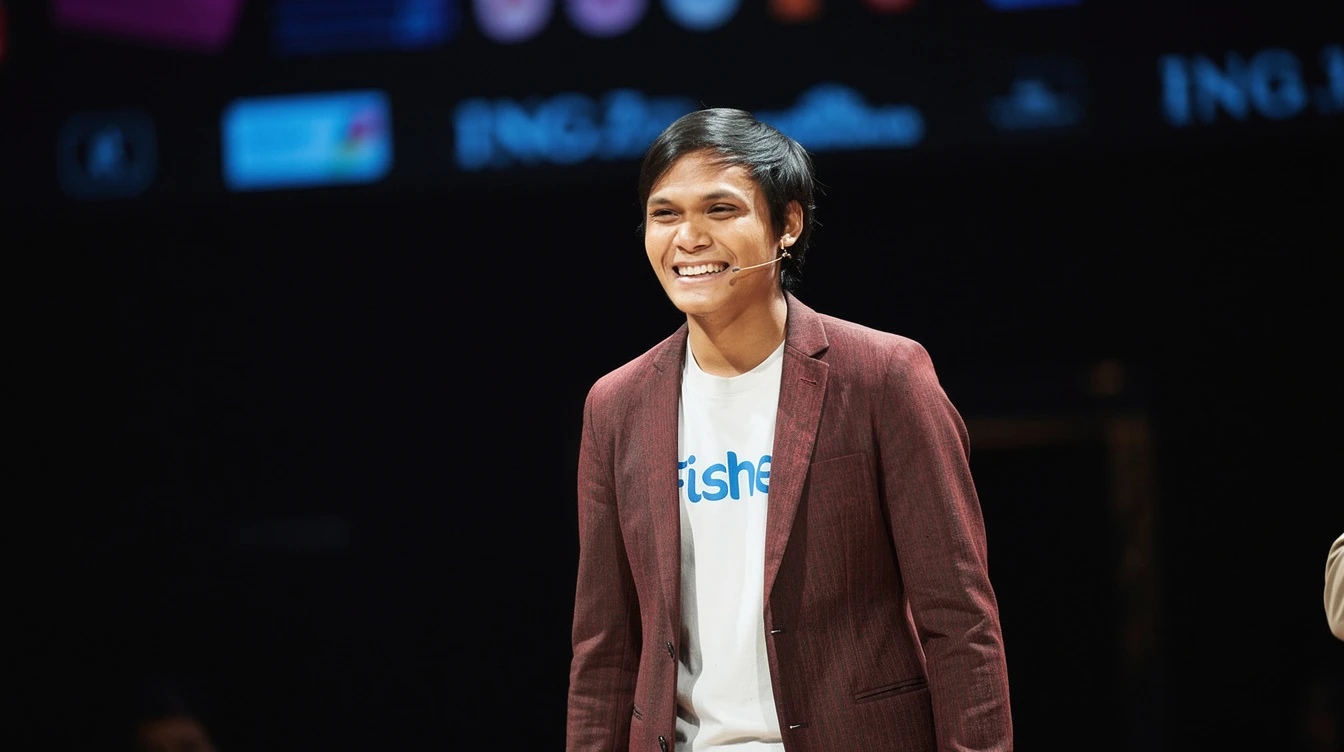
The ascent
What followed was the fastest climb Indonesian agritech had ever seen. Feeders spread across the archipelago’s provinces. The company wrapped an ecosystem around them — feed supply, a marketplace for the harvest, and Kabayan, a financing scheme that stood between smallholder farmers and lenders, with eFishery guaranteeing the loans.
In 2023 came the coronation: a $200 million round valuing the company at $1.4 billion — the world’s first aquaculture unicorn, backed by SoftBank’s Vision Fund, Temasek, Northstar and Malaysia’s public pension fund KWAP. Forbes photographed the founder in a suit and a fish-patterned tie. CNBC ran his tips on how to build a profitable startup.
By then, according to reporting on the later investigation, the books had been cooked for roughly five years.
Fifteen days in December
The unravelling, when it came, took about two weeks.
In early December 2024, an insider quietly alerted a board member to accounting irregularities — the first thread. By 15 December the board had suspended Gibran and a co-founder and installed an interim CEO. The interim CEO lasted a month. In January, a draft report by FTI Consulting — brought in to reconstruct the real numbers — leaked to Bloomberg, and the thread became a hole where a unicorn used to be.
The company had told investors it earned $752 million of revenue in the first nine months of 2024. The draft put the real figure around $157 million. A reported $16 million profit was, in reality, a loss of about $35 million. Of the hundreds of thousands of smart feeders the company claimed in the field, investigators could account for a small fraction. This was not aggressive accounting; it was a parallel fiction, maintained for years.
Inside the Bandung headquarters, employees who had joined a mission demanded transparency as layoff plans loomed — people discovering in the press that the company they worked for was, in large part, imaginary. By February, shareholders had handed the keys to FTI outright: a fish company run by forensic consultants. In August 2025, police detained Gibran and two former executives. The trial, the nine years, and this month’s reduction to six followed.
The wound, up close
To understand what the fraud actually broke, listen to the people closest to it — not the commentators, the participants.
Amy Novogratz’s Aqua-Spark had been there since that first 2015 cheque — nearly a decade of board meetings, farm visits and advocacy. The statement she and her co-founder published this April reads less like an investor update than a bereavement: shock, then anger, then grief at discovering that people she had championed for years “were not who you believed them to be” — in her words, “a different kind of wound.” Her sharpest point is the one worth engraving: eFishery did not need to lie. The company was real, the mission was real — which makes the fraud not just criminal but pointless.
The blast radius reached people who had never heard of a cap table. Bloomberg’s reporting found that of the roughly 28,000 farmers in the Kabayan financing scheme, around half were inactive — and thousands of accounts were frozen while lenders worked out what was real. One Jakarta executive, Adilla Arantika Wiranto, has written a fly-on-the-wall account of the collateral damage: she had left a corporate career to lead the turnaround of a distressed P2P lender, consultants already flown in, term sheets on the table — and then the regulator revoked her target’s licence almost overnight, partly because eFishery, its key partner and loan guarantor, was imploding. Her first C-suite role died with it. Multiply that quiet story across an ecosystem.
And through KWAP, the bill reached Malaysian pensioners: the fund is pursuing recovery of RM163 million while Malaysia’s anti-corruption commission investigates.
Six years, in context
Now hold the sentence against Indonesia’s own statute book. Someone caught with a few grams of cannabis faces a statutory minimum of four years under Article 112 of the Narcotics Law — and even routine paperwork offences, like misusing a stay permit, carry maximums in the same range. Fabricating some $600 million of revenue and burning $300 million of other people’s money: six years, after appeal, and a fine of Rp2 billion — roughly $111,000 — against what vanished.
The uncomfortable truth is that Gibran was not treated leniently by local standards — rather the opposite. Indonesia Corruption Watch’s review of 2024’s corruption verdicts found the average sentence was three years and three months, and that of some Rp330 trillion in state losses across those cases, less than five per cent was ever recovered.
The scale itself is the scandal. In practice, deception measured in hundreds of millions of dollars sits in the same sentencing band as personal drug possession — and the money almost never comes back. That arithmetic, more than any single verdict, is what keeps feeding the calls for an asset-confiscation law we have covered before.
The cultural read — carefully
Is there something Indonesian in all this? Yes and no, and the distinction matters.
No, in the sense that the mechanics — fabricated dashboards, growth theatre, due diligence performed as a ritual on numbers the founder himself controlled — are the same ones that produced Theranos and FTX. The most sophisticated money in the world signed off on this. Nobody gets to condescend to Jakarta.
Yes, in a subtler sense. We have argued before that this ecosystem learned to reward familiarity over proof — to fund the person who looks the part, vouched for by the right circle, ahead of the person with the verifiable record. eFishery was that dynamic at its most seductive, because the founder’s biography was not a polished pedigree but its opposite: the boy who went hungry and built something real. Who audits a story like that? Questioning it felt indecent — and so, for years, too few people did.
And the aftermath feeds the anxiety we described in our reading of this year’s capital outflows: what investors say they are waiting for is not growth but certainty — that numbers are audited, that courts are predictable, that the next unicorn is load-bearing. Every eFishery pushes that certainty further away.
What survives
There is a case for optimism, and it comes, tellingly, from the people who lost money. Alessandro Mele, an investor in Aqua-Spark, wrote this week that he re-invested his own money after the write-off — the thesis survived the fraud, valuations reset, and “dislocation can create opportunity.” Novogratz’s fund has rebuilt its verification processes and kept backing the sector it helped create.
The uncomfortable summary is this. Indonesia’s first agritech unicorn began with a hungry student and a real machine, and ended as a story wrapped around that machine — a story the world’s most careful money paid $1.4 billion for. The founder will serve six years. The farmers, the employees, a Malaysian pension fund and the sector’s credibility are still counting their share of the bill.
The feeder, for what it is worth, still works. Trust is the technology that broke — and nobody has yet built the machine that feeds that back.
This account draws on court outcomes and investigative reporting by Bloomberg, DealStreetAsia, Undercurrent News and others, on ITB’s published profile of its alumnus, and on first-hand reflections by Amy Novogratz (Aqua-Spark), Alessandro Mele (EthicalFin) and Adilla Arantika Wiranto, each linked above. The figures were sourced and verified independently against primary reporting, and any errors are our own. See also our companion pieces on Jakarta’s classroom cartels and Indonesia’s wait-and-see capital.