Indonesia
Companies Reassess AI's Role in Workforce Amid Recruitment Rebounds
A shift in strategy sees firms like Ford and CBA reversing layoffs as they recognize the limitations of AI in handling complex tasks.
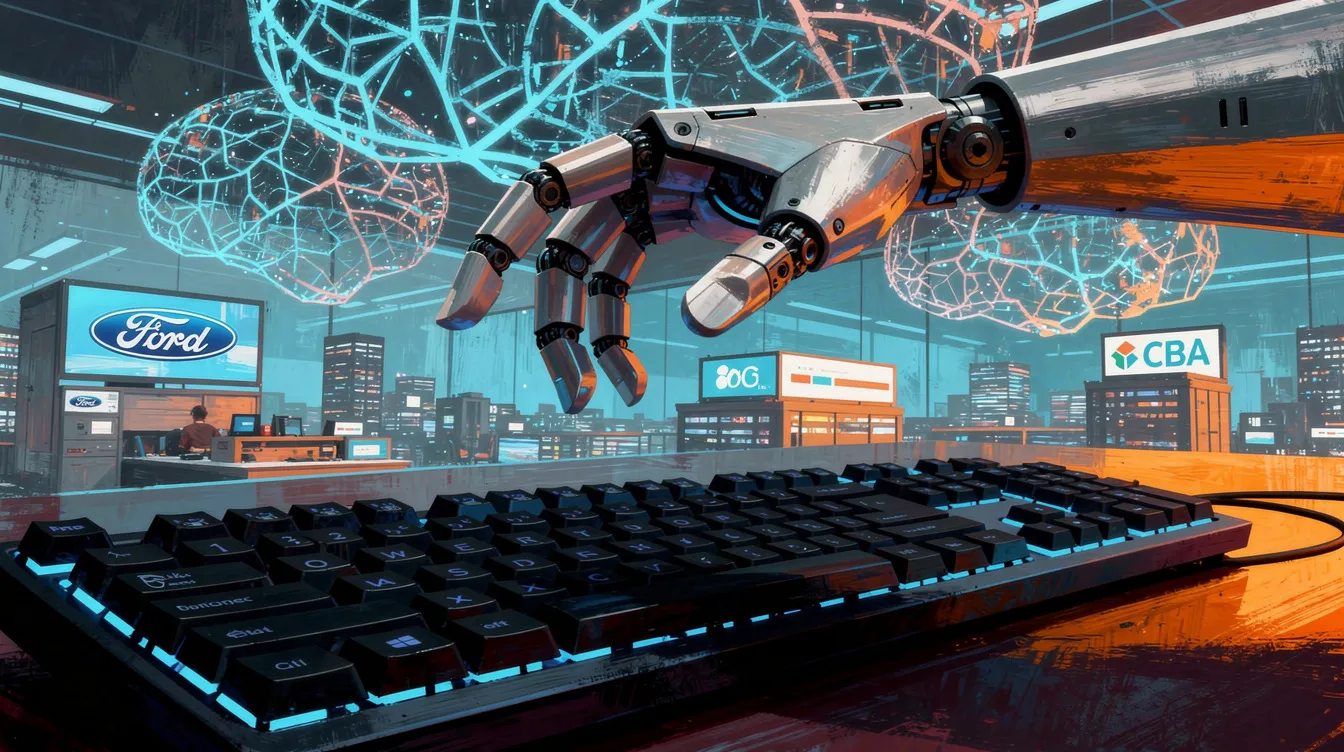
Recent trends indicate that many companies are reevaluating their reliance on Artificial Intelligence (AI) in the workplace. Following a wave of layoffs where human workers were replaced by AI, firms are now reversing course, recognizing that technology alone cannot address all operational challenges.
Ford Motor Company is among the notable firms to rehire hundreds of experienced engineers after discovering that AI systems were insufficient for resolving various product quality issues. Charles Poon, Ford's Vice President of Hardware Engineering, emphasized, "AI is a fantastic tool, but it is only as good as the information you use to train it," highlighting the necessity of human oversight in the process.
“AI is a fantastic tool, but it is only as good as the information you use to train it.”Charles Poon, Vice President of Hardware Engineering, Ford
Similarly, the Commonwealth Bank of Australia (CBA) has reconsidered its strategy after initially planning to cut over 40 customer service positions in favor of AI-driven voice bots. The bank acknowledged that it had not adequately assessed the full range of business implications before moving forward with layoffs. A union representing financial sector workers described the decision to reverse these layoffs as a significant victory.
IBM has also faced challenges with its AI integration, having automated around 94% of routine HR tasks. However, the remaining 6% of cases, particularly those involving ethical dilemmas, proved too complex for AI to manage effectively. Nickle LaMoreaux, IBM's Chief Human Resources Officer, stated, "If we do not continue investing in entry-level hiring, what will happen in three to five years? There will be no talent pipeline; our human resources will dry up completely." This statement underscores the importance of maintaining a human workforce alongside AI advancements.
“If we do not continue investing in entry-level hiring, what will happen in three to five years? There will be no talent pipeline.”Nickle LaMoreaux, Chief Human Resources Officer, IBM
Analysts have noted that the trend of replacing human workers with AI is not necessarily the best strategy for business growth. A report by Intuition Labs pointed out that many companies focused on automation without investing in employee training and skill enhancement, leading to unprepared teams unable to leverage AI effectively. In fact, a significant number of companies that pushed for automation later regretted their layoffs, as they had dismissed personnel essential for supervising AI operations.
According to a report from Orgvue, 39% of business leaders admitted to conducting layoffs due to AI implementation, with 55% of those acknowledging that such decisions were misguided. Jessica Zhang, Senior Vice President for APAC at HR solutions provider ADP, noted that when AI outputs are inconsistent or difficult to apply, companies often find themselves needing to reintroduce human oversight, which can slow decision-making and reduce productivity.
“AI is changing the workplace, but it is becoming clear that organizations find greater value in building collaboration between humans and AI.”Capitol Technology University
Furthermore, data from recruitment firm Robert Half revealed that 32% of hiring managers in the United States have eliminated positions primarily due to AI, only to later rehire for similar roles. This trend suggests that while AI is transforming workplaces, organizations are increasingly recognizing the greater value in fostering collaboration between humans and AI rather than fully replacing human jobs.
Capitol Technology University concluded that while AI is indeed reshaping the work environment, it has become evident that organizations find more value in building a collaborative human-AI relationship than in completely substituting human roles.