The voice of the ASEAN people
INSIDE·ASEANConnecting ASEAN with the World
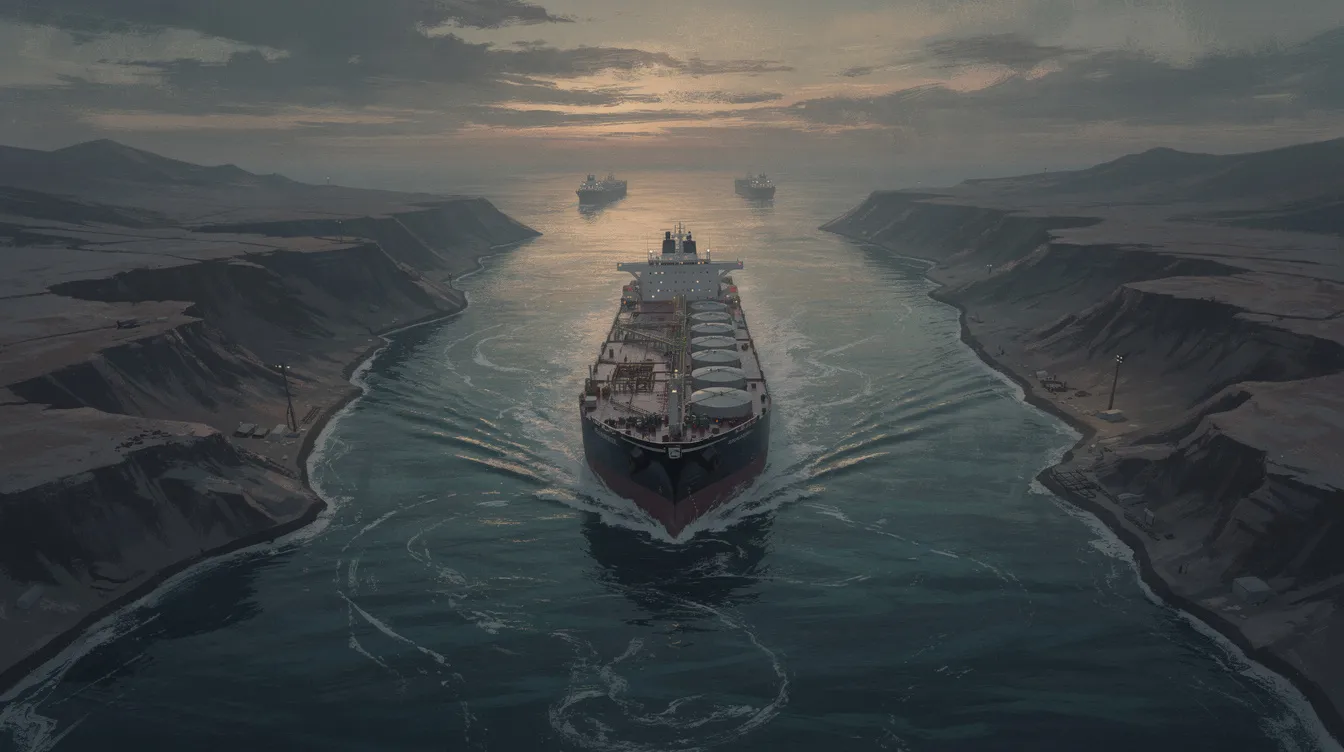
A single 39-kilometre-wide strait carries a fifth of the world's oil — and almost all of it is bound for Asia. When the Iran war closed it, Southeast Asia discovered how differently ten neighbours can bleed from the same wound.
Between the Iranian coast and the tip of the Arabian peninsula lies a channel of water the US Energy Information Administration calls, flatly, "the world's most important oil transit chokepoint." Roughly a fifth of the petroleum the planet burns sails through it. And the striking thing, for a Southeast Asian reader, is where all that oil is going: not west, but east — toward Asia.
In late February 2026, that supply line snapped. As the war between Iran and a US–Israeli coalition escalated, Tehran moved to close the strait — warnings to shipping, attacks on tankers, sea mines. Within days the traffic that normally streams through Hormuz had thinned to a trickle, and the price of crude did what supply shocks always make it do: it jumped. Brent, near $72 a barrel the day the strikes began, crossed $100 within a week and, by the World Bank's reckoning, had climbed about 65 per cent by the end of March — the steepest monthly rise it had on record. It has swung violently ever since, sliding below $70 when a June ceasefire briefly reopened the strait, then rebounding as that deal frayed. The head of the International Energy Agency, Fatih Birol, called the disruption larger than "the three biggest previous major energy shocks combined" — the 1973 embargo, the 1979 revolution and the 2022 invasion of Ukraine.
A barrel of oil is a global price, not a local one — which is the first cruel fact of a chokepoint crisis. It did not matter whether a country bought its crude from the Gulf or from Nigeria; everyone paid the new price. What differed, enormously, was how much each economy had to buy, how much it had stored, and how much cushion its government could afford to place between the world price and its own citizens.
The price of a barrel, before and after2026 data
Brent crude, monthly average, US$/barrel. The shaded band marks the disruption.
Southeast Asia buys around 60% of its oil from the Middle East, the IEA reckons, and the region's own output has fallen by roughly a third since 2000 even as demand keeps climbing. But the aggregate hides the story. The Philippines imports almost all of its crude through the Gulf — the ISEAS–Yusof Ishak Institute puts it near 95% — and holds only enough fuel to last weeks. Vietnam is nearly as exposed, at around 88%, on the thinnest reserves in the region. At the other pole sits Malaysia, a net exporter of oil and gas, which felt the crisis mainly as imported inflation rather than a supply threat. Between them, every neighbour occupies a different point on two axes at once: how much it leans on the strait, and how much it has stored against a day like this one.
Plot those two axes together and the danger zone is obvious — the bottom-right, where heavy dependence meets a shallow buffer. It is not the biggest economies that sit there.
Exposure versus buffer2026 data
Share of crude imported through the Gulf (exposure) against days of fuel reserves (buffer). Bottom-right — high exposure, thin buffer — is the danger zone.
The responses that followed were a live experiment in energy politics. The Philippines declared a state of national energy emergency in late March — the first in the region — and put its government on a four-day week. Thailand, which the ORF notes holds an unusually deep reserve of around 110 days, could afford to cap diesel and even ban most fuel exports, keeping its own tanks full. Indonesia and Malaysia, both of which shield drivers with fuel subsidies, faced a fiscal rather than a physical squeeze: Malaysia's monthly subsidy bill jumped more than four-fold, and Jakarta's began straining a budget written for a world of $70-a-barrel oil. Each government reached for the tools its own energy structure had handed it years earlier.
The policy toolkit
How each government met the shock — and who had room to move.
Behind the barrel price is a motorbike that costs more to fill than a day's wage, a fishing boat that stays in port, a factory that idles for want of feedstock. In the Philippines, government economists at PIDS estimated that crude at $105 would push 1.34 million more Filipinos below the poverty line — and as many as 3.5 million if it reached $145, with the poorest households losing five times as much purchasing power as the richest. Across the region the second-order effects — the ones the UN's trade body flagged early — spread through freight rates, insurance premiums and fertiliser costs into the price of food itself; the World Food Programme warned a sustained shock could tip some nine million people in Asia into acute hunger. Petrochemical plants from Indonesia to Singapore declared force majeure as feedstock dried up; in Vietnam, panic queues formed at the pumps. The strait is far away. The squeeze is not.
None of this would have surprised the people who study oil for a living. Half a century of economics has established two things that the Hormuz crisis simply re-ran. The first, from James Hamilton's landmark 1983 work, is that oil shocks and recessions travel together: nearly every US post-war downturn was preceded by a sharp jump in the crude price. The second, from Lutz Kilian, is subtler and more important here — that the source of a price rise decides its damage.
"Not all oil price shocks are alike."Lutz Kilian, American Economic Review, 2009
A price that climbs because the world economy is booming is one thing; a price that climbs because someone has physically cut the supply is another, and worse. Hormuz was unambiguously the second kind — a genuine supply disruption, the sort Kilian's work identifies as the most contractionary. And Southeast Asia met it with almost no shock absorber. The regional research institute ERIA has warned for years that not a single ASEAN state holds a true national strategic petroleum reserve of the kind the rich importers built after 1973; most run on commercial stocks measured in weeks. History offered one strange comfort. During the 1980s "Tanker War," Iran and Iraq attacked more than 450 ships in and around the Gulf, yet the oil kept moving and real prices actually fell through the decade. A shooting war on the water is survivable. A closed door is the scenario no one had truly priced.
Chokepoints do not respect a country's development plan. Southeast Asia had spent a decade talking about an energy transition measured in decades; a single strait compressed the timetable into a single spring. The states that came through best were not the richest but the best-prepared — Thailand with its reserve tanks, Malaysia with its own wells — and the lesson each capital drew was the same one the world learned in 1973 and keeps forgetting: that energy security is bought slowly, in stockpiles and diversified suppliers and home-grown fuel, long before the day it is needed. The B50 biodiesel plant, the second LNG supplier, the reserve that sits idle for years — they are the boring investments a chokepoint suddenly makes look wise. Whether the region reads the lesson, or waits to relearn it at the next narrow place on the map, is the question the Strait of Hormuz has left behind.
An InsideASEAN explainer, published mid-crisis (July 2026); figures current to press time and revised as the situation develops. Where a number rests on a single source or a forecast, the text says so.