Analysis · ASEAN
Grab and GoTo Are Finally Profitable: Now Indonesia Has Capped Their Commissions at 8%
Within weeks of each other, Grab and GoTo both proved a decade-old question had an answer: yes, this can make money. Then Indonesia capped what they may charge their drivers, an electric fleet took half of Vietnam, and both companies discovered that the discipline which made them profitable is the same discipline that stops them fighting back.
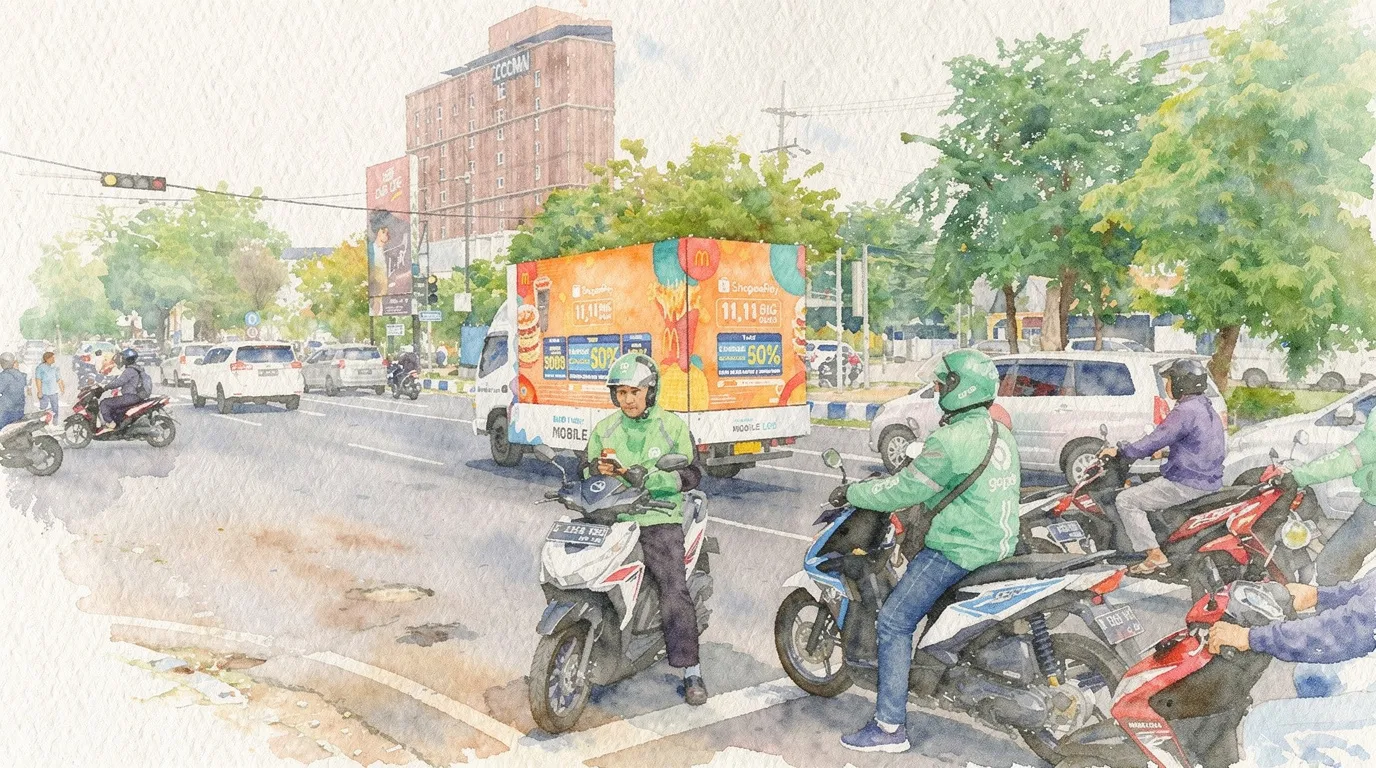
Stand at the till of a minimarket in Jakarta and watch somebody pay.
They hold a phone over a single printed square taped beside the register. That square is QRIS, the national standard Bank Indonesia introduced in 2019, and it accepts everything — GoPay, OVO, DANA, ShopeePay, any bank app in the country. Which wallet the customer actually opens is a decision made in the second and a half before the camera focuses.
GoPay belongs to GoTo. OVO is controlled by Grab. On this particular afternoon neither is offering anything: no cashback, no ten per cent off, no spin-the-wheel. ShopeePay is running a promotion with the merchant. The customer opens ShopeePay.
Nothing about that is disloyalty. There is nothing to be loyal to. The regulator mandated that every wallet read the same code, which means switching costs a shopper precisely one tap, and the only remaining reason to choose one over another is who is paying for the discount that day. For most of the last decade, the answer was Gojek or Grab, because both were willing to buy the transaction. In 2026 they are not, because they have promised their shareholders they have stopped doing that.
That small transaction at the till contains the whole of the problem facing Southeast Asia’s two biggest technology companies in the year they finally started making money.
Two announcements, three weeks apart
In the middle of 2026, two companies that had spent a decade losing extraordinary amounts of money announced that they had stopped.
Grab, listed in New York and headquartered in Singapore, posted the largest profit in its history: US$235 million for the second quarter, against $20 million a year earlier. GoTo, listed in Jakarta and built from the merger of Gojek and Tokopedia, reported a net profit of Rp252 billion — around $15 million — its second consecutive profitable quarter after fourteen years without one.
For anyone who watched these two set fire to roughly a decade of venture capital in pursuit of each other, this ought to have been the end of the story. It is closer to the beginning of a harder one.
What a decade of war actually cost
The origin stories are almost comically parallel. In 2012 Anthony Tan, heir to a Malaysian car-distribution fortune, entered a Harvard Business School competition with a plan to make Kuala Lumpur’s taxis safer; it became MyTeksi, then GrabTaxi, then Grab, and moved to Singapore. Two years earlier in Jakarta, Nadiem Makarim — also a Harvard MBA — had started Gojek as a call centre dispatching twenty motorcycle-taxi drivers. Both had spotted that Southeast Asia moved on informal transport, that informal transport ran on haggling, and that a smartphone could settle the price before anyone got on the bike.
Then the capital arrived, and the competition stopped being about products. SoftBank funded Grab; Google, Tencent and Sequoia funded Gojek. Both adopted the era’s defining manoeuvre: sell a dollar of service for seventy cents and book the difference as market share. Rides in Jakarta sometimes cost less than the petrol burned to deliver them. Drivers collected sign-up bonuses from one app while carrying passengers subsidised by the other. Food delivery, payments, groceries and logistics were bolted on less because they earned anything than because the rival had bolted them on first.
The most eloquent verdict on that period came from the company that invented the playbook. Uber entered Southeast Asia, spent by its own reckoning around $700 million, and in March 2018 handed its entire regional operation to Grab in exchange for 27.5% of the company and left.
The public markets delivered the second verdict. Grab listed on Nasdaq in December 2021 through what was then the biggest SPAC merger ever attempted and closed its first day worth $34.6 billion. It has not been worth that since. GoTo listed in Jakarta in April 2022 and traced the same curve downward. Rates rose, the growth-at-any-cost era shut, and two companies engineered to outspend one another were instructed — by the very investors who had funded the spending — to stop.
Arrival, on two different balance sheets
What followed was four years of subtraction. Incentives were trimmed and then trimmed again, marketing budgets collapsed, and staff left in waves. GoTo’s retreat was the more radical, because its balance sheet allowed less patience: in January 2024 it handed control of Tokopedia to TikTok for $840 million, after Indonesia’s ban on social-commerce left TikTok needing a licensed local vehicle. GoTo kept a minority holding and walked away from e-commerce — half of what its name stood for.
The results now read like two versions of the same discovery.
Grab’s second quarter brought revenue of $997 million, up 22%, on-demand gross merchandise value of $6.5 billion, up 21%, and adjusted EBITDA up 54% to $168 million. Profit growing at more than double the rate of revenue is the definition of operating leverage — costs no longer rise with the business — and it is the most important line in the release. Management raised full-year guidance to revenue of $4.10–4.15 billion and adjusted EBITDA of $720–740 million.
GoTo’s quarter was arguably the more dramatic. Group net revenue rose 31% to Rp5.7 trillion and adjusted EBITDA reached Rp1.01 trillion, up 137% and crossing the one-trillion-rupiah line for the first time. Annual transacting users reached 71 million, up 19%. Cash stood at roughly Rp23.5 trillion, about $1.4 billion.
One caution belongs on Grab’s headline figure, because the gap between it and the operating business is wide. Of the $235 million, $307 million was a one-time gain recognised on consolidating the digital bank Superbank from June, and a further $66 million arrived as deferred tax recognition. Operating profit was $19 million. That is a genuine milestone and it is a twelfth of the headline; the market, moving 4.14% after hours, priced the operating business rather than the accounting.
The pivot neither company announced
Buried in both sets of results is the same structural shift, and it is the most consequential fact of the year for either business.
At Grab, financial services revenue grew 59% to $134 million — the fastest-growing line in the company. At GoTo, the fintech arm grew 447% and, for the first time ever, its adjusted EBITDA overtook on-demand services. The lending, payments and deposit business now out-earns the rides and the food.
Put plainly: both companies are becoming financial institutions with transport networks attached. The motorbikes and the delivery bags increasingly function as customer-acquisition machinery and as a credit-scoring dataset — a driver’s daily earnings history is a better loan underwriting signal than anything a traditional Indonesian bank holds on the same person. Grab consolidated Superbank; GoTo has its own banking and lending stack.
There is an awkwardness in it, though, and the minimarket till is where you see it. The payments half of that financial business runs on QRIS, and QRIS was built precisely to stop any one wallet owning a customer: no Indonesian wallet holds much more than a quarter of the market, and the one most people name first is ShopeePay, which belongs to neither of them. Lending is defensible, because a loan book built on knowing what sixty million drivers and merchants actually earn is genuinely hard to copy. Payments, by regulatory design, are not.
None of this is opportunism. It is a response to something happening underneath the transport business.
Eight per cent
On 1 July 2026, Indonesia capped what ride-hailing platforms may deduct from a two-wheeled driver’s fare at 8%. Presidential Regulation 27/2026 followed sustained protests by driver unions across major cities and was confirmed by the transport minister as in force from that date, with 92% of the fare going to the driver. Four-wheel services remain under negotiation.
Platforms had generally been taking somewhere around 15–20%. Halving the take rate in the region’s largest market, on its highest-volume product, is something no amount of cost optimisation reaches. It sets a ceiling on what the core business can ever earn per ride, imposed by the state, in the same year both companies finally made that business work.
Seen against that, the migration into lending stops looking like diversification and starts looking like necessity. The regulator can cap a commission. It is much harder to cap the economics of a loan book built on proprietary data about how much sixty million drivers and merchants actually earn.
The competitors who are not playing the same game
The second squeeze comes from below, and it is arriving fastest where nobody was watching.
Xanh SM came out of heavy industry rather than the technology sector: an electric taxi operator seeded by Pham Nhat Vuong, Vietnam’s richest man, running roughly 100,000 VinFast vehicles — built by his own group — across 61 provinces, launched only in 2023. By the fourth quarter of 2025, researchers put it at 51.5% of Vietnamese ride-hailing by gross merchandise value against Grab’s 42.6% — in a market where Grab once held more than 70%. It has since raised its capital base above $1 billion and moved into Laos and Indonesia. Vietnam’s Be Group, meanwhile, reached profitability on subscription bundles rather than commissions.
In Indonesia, inDrive — which lets passengers and drivers negotiate the fare directly, a model that looks a great deal like the haggling Gojek was built to abolish — and Maxim are both operating under the new 8% cap, inDrive formally adopting it in July. A commission ceiling hurts an incumbent defending a margin far more than a challenger buying share.
The pattern across all of them is that they are not optimising for quarterly EBITDA. Xanh SM answers to a conglomerate pursuing an electric-vehicle strategy; inDrive and Maxim are private and playing a longer game. None of them has to explain a margin contraction to public shareholders in ninety days.
The trap inside the good news
Which is the uncomfortable position both incumbents now occupy. The discipline that produced these results is the same discipline that prevents them responding as they once would have.
Grab is sitting on $7.4 billion of gross cash, $5.4 billion net of borrowings — and its board has just authorised another $750 million of buybacks, taking cumulative authorisation to $1.75 billion since 2024. A company that spent its first decade converting cash into market share is now converting cash into its own shares. Net of that cash pile, the market values everything Grab actually operates — every ride, delivery and loan across eight countries — at under $10 billion, against $34.6 billion on its first public day.
That is a rational allocation when the alternative is another subsidy war. It is also a promise to shareholders that is expensive to break. Should Xanh SM’s Indonesian expansion start biting, or a fare war open in Jakarta under the new commission regime, both companies would have to choose between defending share and defending the profitability they have only just demonstrated. Neither has faced that choice yet with public investors watching.
Which is why the merger will not go away
The region’s longest-running open secret is that Grab might simply absorb GoTo. Talks valuing GoTo at around $7 billion have surfaced, stalled and resurfaced since 2024; Grab has denied active negotiations. Indonesia’s competition authority has flagged the obvious objection: a combined entity would hold something like 85% of Southeast Asian ride-hailing GMV, and roughly 90% in Indonesia and Singapore. Jakarta’s sovereign wealth vehicle now hovers over any transaction involving the country’s most visible technology company, making it a question of state as much as of shareholders.
The strategic case, though, gets stronger with every quarter of this squeeze rather than weaker. Two disciplined platforms, each holding adjacent near-monopolies, each watching its take rate capped and its transport margins attacked by opponents who do not need to report EBITDA, have more reason to combine than to keep circling.
The decade of open warfare is genuinely over, and both sides can finally show a profit for having survived it. What arrives next is slower, more regulated and more crowded: a phase where the winning move is no longer outspending the rival but out-lending them, and where the most dangerous competitor is the one who owns the factory that builds the cars.