Analysis · ASEAN
Buddhism as Statecraft: Why Shared Faith Didn’t Stop the Thai–Cambodian War
India and China are competing for influence in Southeast Asia through shared Buddhist heritage, and small states from Singapore to Bhutan have learned to trade on it. Then two of the region's most devoutly Buddhist countries spent a year shelling each other, and a Muslim-majority neighbour had to broker the ceasefire.
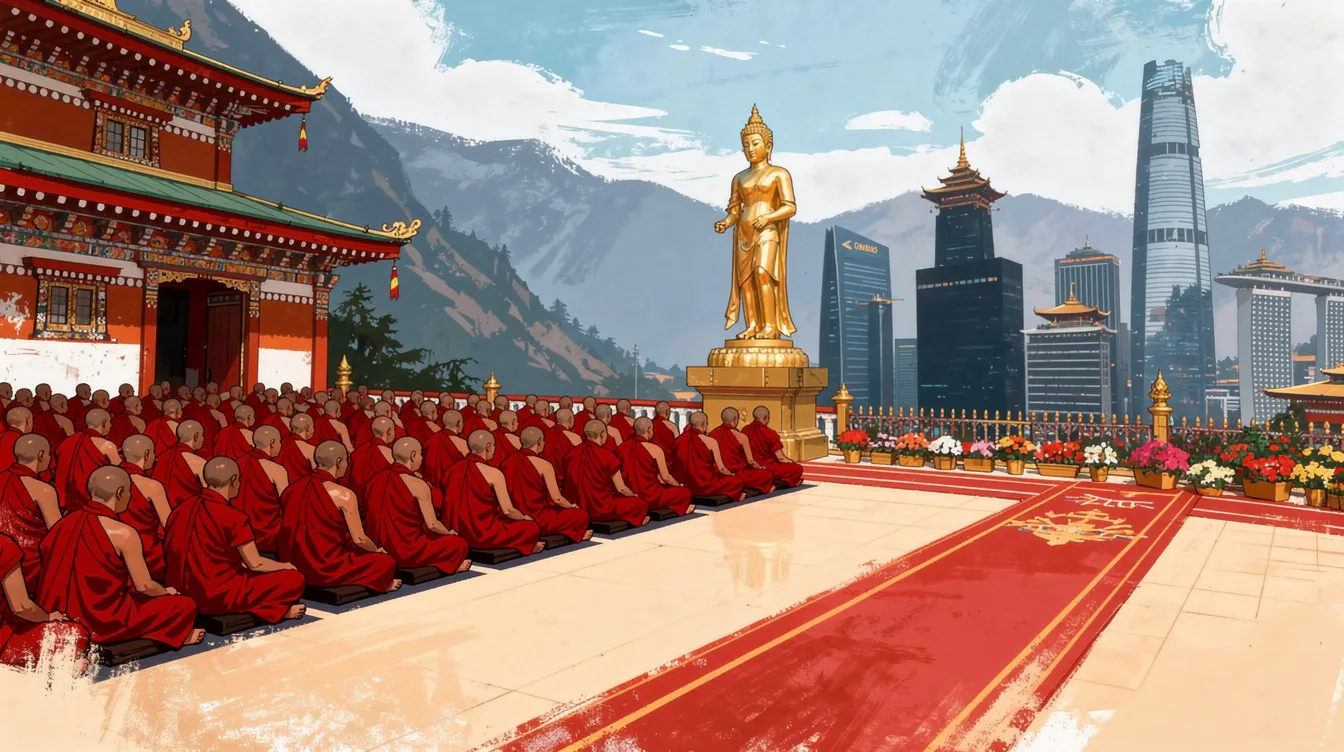
Atop a cliff in the Dangrek mountains stands an eleventh-century temple that is now too dangerous to visit. Preah Vihear, built by the Khmer empire and dedicated to Shiva, has stood on that escarpment for nine hundred years. Three months after a ceasefire, Cambodian authorities reported its walls unstable and the site closed to visitors over unexploded ordnance.
The damage was done by Thailand and Cambodia, two of the most thoroughly Theravada Buddhist societies on earth, in a border war that ran through 2025. More than a hundred people were killed and over half a million displaced. A ceasefire was signed in Putrajaya in July, mediated by Malaysia, a Muslim-majority state, with encouragement from Washington and Beijing. It collapsed by December, and a second agreement had to be signed at a checkpoint in Chanthaburi on 27 December.
During the same period, Buddhism was being promoted across Asia as an instrument of peaceable statecraft. Both things are true, and holding them together is the only way to understand what religious soft power in this region actually does.
A working instrument, precisely defined
Buddhist diplomacy is now a subject with its own scholarly literature rather than a diplomatic flourish. A comparative study published in Frontiers in Political Science defines it as the deliberate use of Buddhist heritage, symbols, values, institutions, sacred sites, pilgrimage routes, monastic communities and transnational religious networks — by states and non-state actors alike — to shape perceptions, build cultural influence and pursue foreign-policy objectives.
The framing matters because it does not require cynicism. Devotion and strategy coexist comfortably; a pilgrimage can be both sincere and useful. What the literature identifies is that the useful part has been noticed, resourced and organised.
Two great powers, one inheritance
The contest that drives most of this is between India and China, and their positions are asymmetric.
India holds the origin claim. The Buddha lived, taught and died in what is now India and Nepal, and the principal sites — Bodh Gaya, Sarnath, Nalanda — are Indian territory. As the Observer Research Foundation has documented, Delhi has built an increasingly deliberate strategy on that inheritance, developing pilgrimage circuits and reviving Nalanda as a university.
China's position rests on scale and infrastructure rather than provenance. Beijing has hosted international Buddhist forums, restored pilgrimage sites, and cultivated Theravada monastic networks in Thailand, Sri Lanka and Myanmar. Writing in the Journal of Current Chinese Affairs, David Scott traced how Buddhism entered the operational vocabulary of Chinese and Indian diplomacy toward one another; the Carnegie Endowment had already called it a new frontier of the rivalry a decade ago.
Southeast Asia is where that competition lands, because this is the Theravada heartland: Thailand, Myanmar, Cambodia and Laos, with substantial communities in Vietnam and Singapore. Roughly 150 million Buddhists live in ASEAN. When Delhi or Beijing sends a relic on tour or funds a monastery restoration, the audience is here.
What small states do with it
The interesting manoeuvres belong to states too small to compete on scale, and there are two distinct models.
Singapore treats Buddhism as one cultural asset among several, deployed from a secular and multireligious base. The late Venerable Hong Choon built extensive monastic ties with Thailand and China and was recognised by King Bhumibol Adulyadej as Supreme Chinese Monk. As foreign minister, George Yeo championed the revival of Nalanda, arguing that shared civilisational heritage could carry regional cooperation. The Asian Civilizations Museum has become an instrument in its own right, and its forthcoming Dunhuang exhibition, organised with the Dunhuang Academy in China, is a straightforward example: Singapore does not claim the heritage, it convenes it. That is the connector role the city-state plays in most domains, applied to religion.
Bhutan — not an ASEAN member, and useful here precisely as a contrast — does the opposite. As the world's only officially Vajrayana kingdom, it treats Buddhism as constitutive of the state rather than as an asset it holds. Gross National Happiness, formulated under the Fourth King, Jigme Singye Wangchuck, made cultural preservation a measure of development. For a landlocked country of under a million people between India and China, with no formal diplomatic relations with Beijing, a distinct civilisational identity is a sovereignty instrument. Recent exchanges with Thailand, including King Vajiralongkorn's visit in April 2025 and an honorary doctorate conferred on King Jigme Khesar Namgyel Wangchuck by Chulalongkorn University, show two Buddhist monarchies conducting relations in a shared symbolic language.
Both models work on their own terms. Neither was ever tested against a genuine dispute between Buddhist states, which is what makes 2025 instructive.
The test, and the result
The Thai–Cambodian quarrel is territorial, not theological. It descends from colonial-era boundary maps and a 1962 International Court of Justice ruling that awarded the Preah Vihear temple to Cambodia while leaving the surrounding land ambiguous. Nothing about it is a religious dispute.
That is the point. If shared Buddhist identity carried the restraining force attributed to it in the soft-power literature, a border argument between two Theravada states with entwined monastic traditions and mutually recognised royal patronage of the sangha ought to have been the easiest case available. Instead there was artillery, rocket fire and air operations across at least twelve border sites, and Buddhist scholars issued public appeals for non-violence and compassion — the intervention of people with moral standing and no leverage.
The mediation that worked came from ASEAN's institutional machinery under Malaysia's chairmanship, backed by American and Chinese pressure. Religion supplied the vocabulary of the appeals and none of the mechanism of the settlement.
The harder limit
Myanmar marks the boundary of the concept more starkly, and it deserves stating plainly rather than being left out.
Researchers of Myanmar's politics have documented at length how Buddhist nationalist movements and monastic organisations became entangled with military authority and with campaigns against Rohingya Muslims, culminating in the 2017 expulsions that drove more than 700,000 people into Bangladesh. Buddhism in that context functioned as a language of exclusion at home while remaining an asset abroad. Any account of Buddhist heritage as a diplomatic resource has to sit alongside that record, which concerns how states and movements deploy a religion rather than the content of the religion itself.
What this means for the region
Buddhist diplomacy is real, it is growing, and it works in one direction. It positions states externally: it gives Delhi a claim on Southeast Asian affection, gives Beijing a channel into monastic networks it could not otherwise reach, gives Singapore something to convene and Bhutan something to be. Those are genuine returns, and ASEAN governments are right to bank them.
What it does not appear to do is generate obligations between the states that share it. Shared faith did not keep a nine-hundred-year-old temple out of artillery range, and it did not stop half a million people leaving their homes. For a region that talks often about shared civilisational values as a foundation for cooperation, that gap is worth naming: values are effective as an instrument of presentation, and so far unproven as a constraint on behaviour.
The more useful question for the next decade is therefore not how much Buddhist heritage ASEAN states can trade on abroad, but whether any of the region's shared inheritances — religious, cultural or institutional — can be made to carry weight when two members fall out. On the evidence of Preah Vihear, that work has not yet been done.